Print Material

From Tradeshow Graphics to Soft Signage: How the Right Banner Material Supplier Powers Every Application

Tension Fabric Displays: How to Choose the Right Fabric

Tension Fabric Displays: How to Choose the Right Fabric 1024 576 Howell Studios

A tension fabric display is a printed polyester fabric graphic stretched taut over a lightweight aluminum frame, held in place by a sewn silicone edge (SEG) or pole pockets. The frame gives it shape. The fabric decides whether it looks sharp on the show floor or sags, wrinkles, and shows the tubing underneath.

Most buying guides focus on the frame kits. This one focuses on the part that actually prints: the fabric. As a materials manufacturer that has supplied digitally printable textiles for over 40 years, UltraFlex Systems sees the same problem repeatedly. A print provider chooses a display system, then discovers the fabric was the variable that mattered most. Weight, opacity, stretch, print method, and fire rating separate a display that photographs well and lasts several seasons from one that gets remade after one event.

Key Takeaways

  • A tension fabric display stretches a dye-sublimated polyester fabric over an aluminum tube or extrusion frame, tensioned by a silicone edge graphic (SEG) or pole pockets.
  • The fabric, not the frame, drives image quality. Weight (measured in ounces), opacity, and knit construction determine whether the frame shows through and how the graphic drapes.
  • Opacity matters most on freestanding structures. A more opaque stretch fabric hides frame and tubing shadows that a thin fabric reveals.
  • Dye-sublimation printing gives the most vivid, wash-durable color on polyester, while latex and UV suit shorter runs and mixed shops.
  • Fire ratings are not optional. Most convention centers require fabric graphics to meet a recognized flame-resistance standard before they enter the hall.
  • PVC-free and recycled-content fabrics now cover most tension display applications, so sustainability rarely forces a quality trade-off.

What is a tension fabric display?

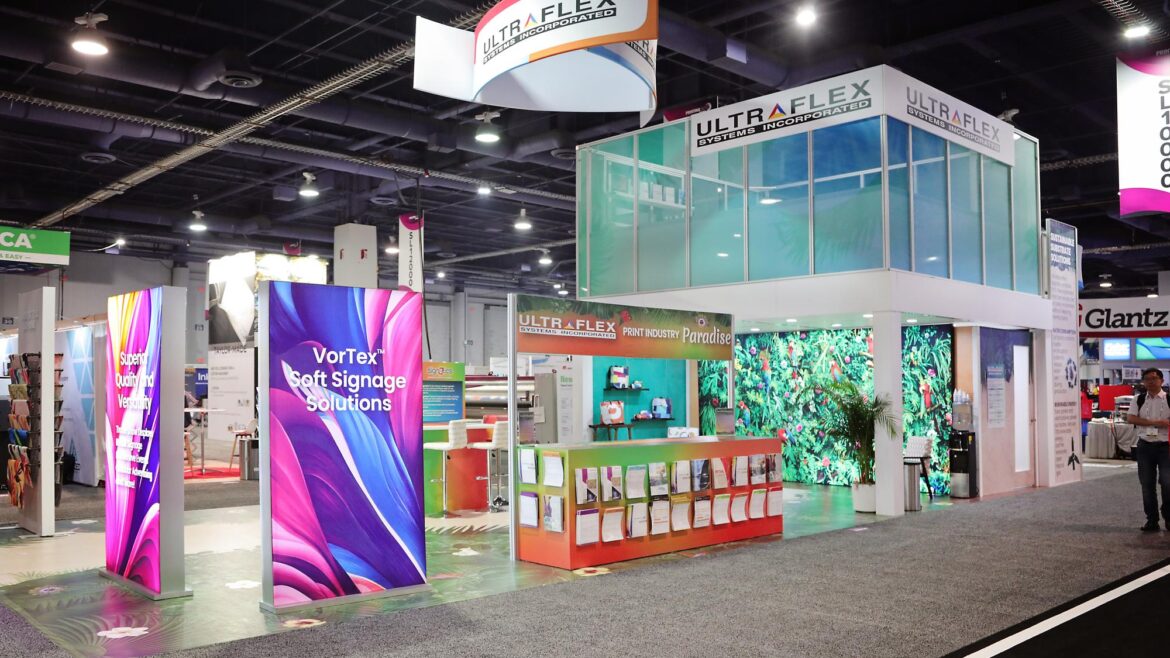
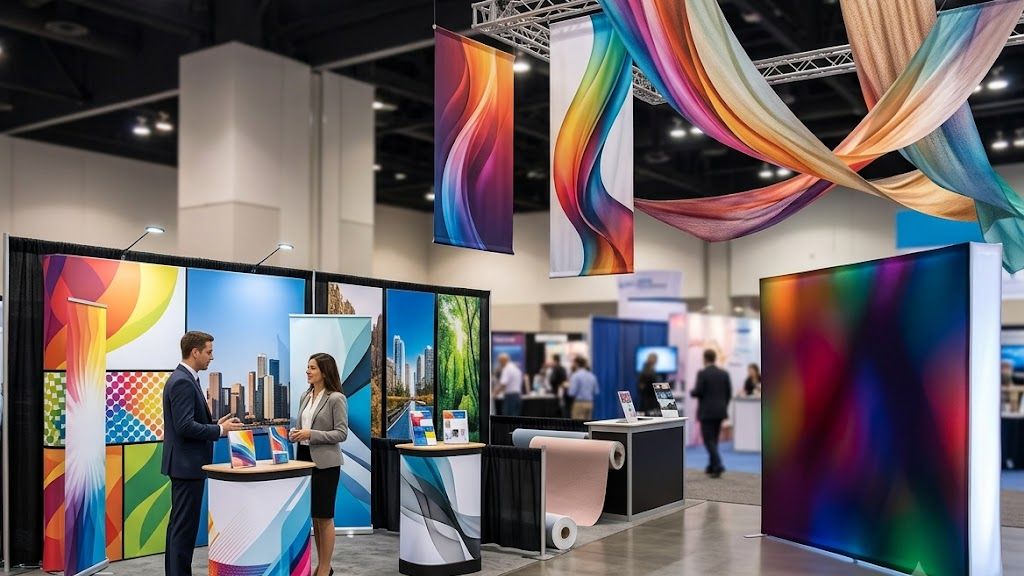
A tension fabric display is a graphic system that stretches a printed polyester fabric over a lightweight aluminum frame and holds it taut with a silicone edge strip or pole pockets. The tension removes wrinkles and creates a smooth, frameless graphic surface. Common formats include straight and curved backwalls, tension fabric backdrops, hanging structures, pillowcase-style banners, and tabletop displays.

The U.S. B2B exhibition industry has nearly rebuilt its pre-pandemic strength. In 2024, 37.0 percent of completed events surpassed their pre-pandemic performance, up 8 percentage points from 2023, according to the Center for Exhibition Industry Research (CEIR). That rebound keeps demand high for portable, reusable booth graphics. Tension fabric systems win here because one printed fabric skin packs into a soft case, installs without tools, and swaps out without replacing the frame.

The system has three parts: the aluminum frame (tube or extrusion), the printed fabric graphic, and the finishing that connects them (an SEG strip or sewn pole pockets). UltraFlex supplies the middle part, the printable textile, through its VorTex Soft Signage line. The frame and the print are only as good as the fabric between them.

Why fabric is replacing rigid and vinyl signage

Printed fabric is displacing rigid panels and PVC banners because it ships lighter, reuses across events, and prints as one clean piece at wide sizes. The market reflects the shift. The global dye-sublimation printing market is forecast to grow from about USD 16.85 billion in 2026 to USD 28.05 billion by 2031, a 10.72 percent compound annual growth rate (Mordor Intelligence). Two independent research firms put digital textile printing on a similar climb, both landing near a 13.8 percent CAGR through the mid-2030s (Precedence Research, Fortune Business Insights).

The practical wins are concrete. Fabric folds into a fraction of the freight volume of a boxed rigid display, which lowers shipping cost and shrinks the carbon footprint of every event.

Fabric also holds up to reuse. A dye-sublimated polyester graphic can be folded, shipped, and reinstalled repeatedly, and many fabrics are washable. There is no glare under booth lighting the way there is on laminated rigid signage. And because fabrics run wide, large graphics can be printed as a single piece with no seam. UltraFlex stocks VorTex soft signage fabrics in 126 inch widths, wide enough to cover most backwalls without a seam.

For a broader look at choosing print substrates, our guide on how to choose banner material covers the trade-offs across vinyl, mesh, and fabric.

The fabric decides whether the frame shows through

Opacity is the spec buyers underestimate most. VorTex Soft Stretch T222 is a 6.48 ounce knitted polyester fabric that is more opaque than comparable stretch products, which lets it hide the frame and tubing structures behind a tension display where a thinner fabric would reveal shadow lines. On a freestanding, front-lit backwall, that opacity is the difference between a clean graphic and one with the skeleton showing through.

Three fabric properties drive the result:

  • Weight. Heavier fabrics (measured in ounces per square yard) are more opaque and drape with more body. Lighter fabrics pack smaller and stretch more easily over curved frames.
  • Construction. A knitted fabric stretches in multiple directions, which is what lets a tension graphic pull drum-tight over a frame without puckering at the corners.
  • Drape and recovery. The fabric must stretch during installation and recover its shape without permanent distortion after repeated setups.
Fabric type Typical use What to prioritize
Light knit stretch Curved frames, tight-tension SEG backwalls Stretch and recovery
Opaque stretch (heavier) Freestanding front-lit backwalls Opacity to hide the frame
Backlit fabric Lightboxes and illuminated displays Even light diffusion
Soft drape textile Table throws, hanging banners Wrinkle resistance and hand feel

UltraFlex organizes its VorTex line into T, D, and S families so print providers can match construction to application. The VorTex T Line includes both the opaque Soft Stretch T222 for structural displays and lighter fabrics like VorTex Soft T230, a 100 percent polyester knit built for banners and table throws with a smooth print surface and soft drape.

Frontlit versus backlit tension fabric

Match the fabric to how the display is lit. A front-lit tension display, the standard trade show backwall, needs an opaque fabric that reads well under ambient and spotlighting. A backlit tension display, built into an illuminated lightbox, needs a fabric engineered to diffuse light evenly so the graphic glows without hot spots or visible lamps.

Using a front-lit fabric in a lightbox produces uneven brightness. Using a backlit fabric on a freestanding wall can let the frame show through. UltraFlex produces dedicated backlit soft signage such as VorTex Backlit Event T202 and VorTex Backlit LX D300 for illuminated builds, alongside its front-lit stretch fabrics. If your project involves illuminated graphics, our backlit film buyer’s guide explains the light-diffusion trade-offs in more detail.

Silicone edge graphics (SEG): how the fabric is finished

A silicone edge graphic is a fabric print with a thin silicone strip sewn around its perimeter that presses into a channel in the frame, producing a taut, frameless, edge-to-edge graphic. SEG is the finishing method behind most modern tension fabric displays and lightboxes because it hides the frame completely and lets graphics swap in seconds.

SEG puts real demand on the fabric. The material has to be dimensionally stable so the sewn silicone strip lines up with the frame groove after printing and finishing, and it has to hold tension without the print cracking at the fold. Dye-sublimated polyester handles this well because the color penetrates the fibers rather than sitting on the surface. Related formats such as fabric pop up displays and tension fabric banners rely on the same fabric behavior, just with different frames.

Dye-sublimation versus latex and UV printing

Choose the print method by run length, equipment, and durability. Dye-sublimation transfers dye into polyester fibers under heat, producing vivid, wash-durable color that will not crack when the fabric stretches. It is the standard for high-volume soft signage. Latex and UV printing put ink on the fabric surface and suit shorter runs or shops that print multiple substrates on one machine.

The practical answer for most providers is to stock fabrics that print more than one way. VorTex Soft Stretch T222 and VorTex Soft T230 are both compatible with UV, latex, solvent, eco-solvent, and screen printing in addition to dye-sublimation, so a shop can match the method to the job without changing media. Many UltraFlex fabrics are also HP Latex certified, which removes the guesswork from color profiling on latex hardware.

Fire ratings and exhibit-hall compliance

Fabric graphics that enter a convention center almost always have to meet a recognized flame-resistance standard, most often NFPA 701, the standard fire test for flame propagation of textiles and films, and show marshals can pull noncompliant displays from the floor. A missing fire certificate can cost an exhibitor the booth on setup day, so the fabric’s rating is a purchasing requirement, not an afterthought.

Verify two things before you buy: that the fabric itself carries a fire rating, and that the manufacturer can supply the certificate your venue asks for. UltraFlex VorTex fabrics, including the Soft Stretch T222 and Soft T230, are fire resistant, and the company publishes downloadable fire certificates so exhibitors can document compliance in advance.

Sustainable tension fabric options

Sustainability in a tension display is decided by the fabric, because the frame gets reused for years while the printed skin is the consumable. The material choice carries the footprint. Recycled polyester holds roughly 50 to 78 percent less embodied carbon than virgin polyester, about 0.68 to 1.56 versus 3.12 kilograms of CO2 equivalent per kilogram (Carbonfact). Printing on a recycled-content or PVC-free fabric is the most direct way to cut a display’s footprint without giving up performance.

UltraFlex offers PVC-free and recycled-content routes for tension displays. Its EcoVantage line is 100 percent PVC-free and phthalate-free, designed to be recycled or safely incinerated without releasing harmful toxins, with EcoVantage 190 recyclable under PET code number 1. Its ReSource line brings recycled content into soft signage fabrics such as ReSource Backlit Event T202 and ReSource Heavy D280. Both sit in the sustainable substrate range and print on standard equipment, so switching does not require new hardware.

Embodied carbon

Recycled polyester against virgin polyester

Kilograms of CO2 equivalent per kilogram of fabric.

Recycled polyester (low)0.68 kgRecycled polyester (high)1.56 kgVirgin polyester3.12 kg

Carbonfact: recycled polyester holds roughly 50 to 78 percent less embodied carbon than virgin polyester.

How to spec and order the right fabric

Work through five questions before you order, in this order:

  1. Lighting. Front-lit or backlit? This decides the fabric family first.
  2. Structure. Freestanding wall (prioritize opacity) or curved SEG frame (prioritize stretch)?
  3. Print method. Dye-sublimation, latex, or UV? Confirm the fabric supports your machine.
  4. Compliance. Which fire standard does the venue require, and can you get the certificate?
  5. Sustainability. Does the client need PVC-free or recycled content?

The fastest way to de-risk a fabric choice is to print a proof on the actual media. UltraFlex lets print providers request a sample of any VorTex fabric to test opacity, stretch, and color on their own hardware before committing to a full roll. For project-specific guidance, the team can be reached through the contact page or at (973) 627-8608.

Frequently Asked Questions

What is the difference between a tension fabric display and a pop-up display?

A tension fabric display stretches a single printed fabric skin over a rigid aluminum frame for a taut, seamless graphic. A pop-up display uses an accordion-style expanding frame with graphic panels attached to it. Many fabric pop up displays now use tension fabric skins, so the line between the two has blurred, but the defining feature of a tension fabric system is the drum-tight fabric held by an SEG strip or pole pockets.

What fabric is used for tension fabric displays?

Most tension fabric displays use dye-sublimated knitted polyester. For freestanding front-lit walls, an opaque stretch fabric such as a 6.48 ounce knit hides the frame. For backlit lightboxes, a light-diffusing backlit fabric is used. For table throws and hanging banners, a lighter soft-drape polyester works best.

Are tension fabric graphics washable and reusable?

Yes. Dye-sublimated polyester graphics are designed to be folded, shipped, and reinstalled repeatedly, and many are washable because the dye is embedded in the fibers rather than printed on the surface. That reusability is a major reason fabric displays cost less over multiple events than single-use rigid or vinyl signage.

Do tension fabric displays need to be fire rated?

Usually, yes. Most convention centers and exhibit halls require display fabrics to meet a flame-resistance standard such as NFPA 701, and the show marshal can remove a display that lacks documentation. Choose a fabric that carries a fire rating and confirm the manufacturer can provide the matching certificate before the event.

What is a silicone edge graphic (SEG)?

A silicone edge graphic is a fabric print with a thin silicone strip sewn around its edge. The strip presses into a groove in the display frame, pulling the fabric taut for a smooth, frameless, edge-to-edge look. SEG is the standard finishing method for modern tension fabric displays and backlit lightboxes.

Backlit Film: How to Choose the Right Backlit Media

Backlit Film: How to Choose the Right Backlit Media 1280 825 Howell Studios

Backlit film is a translucent print substrate designed to be lit from behind, so a graphic glows with even, saturated color inside a light box, display case, or illuminated sign. Choosing the right backlit media is mostly a question of matching the base material, weight, and ink system to how the piece will be lit and where it will live. Get that match right and the print reads clean and bright with no hot spots. Get it wrong and you see banding, pinholes, or a washed out image the moment the lights come on.

This guide walks print buyers and production managers through what backlit film is, how it differs from frontlit media, the specs that actually matter, and where it performs best.

Key Takeaways

  • Backlit film is a translucent substrate printed to be illuminated from behind, used in light boxes, displays, and internally lit sign faces.
  • The two common bases are smooth PET film and woven polyester fabric. Film gives a glass-flat surface for framed light boxes, while diffusion-layer fabric spreads light evenly across large tension displays.
  • Match weight, opacity, and the light-diffusion layer to your fixture. A dedicated backlit product resists the hot spots and pinholes you get when you push a frontlit material into a light box.
  • Confirm ink compatibility before you buy. Backlit media are formulated for specific systems such as UV, latex, solvent, and dye sublimation.
  • Backlit graphics sit inside a growing illuminated-display market, and a stocked North American supplier keeps high-volume shops from waiting on backorders.

What is backlit film?

Backlit film is a print media engineered so light passes through it evenly, letting a printed image glow from within a fixture instead of relying on reflected room light. It is the material behind mall light boxes, airport dioramas, menu boards, retail displays, and internally illuminated sign faces.

Demand for illuminated messaging keeps climbing. U.S. out of home advertising revenue reached a record $9.46 billion in 2025, up 3.6% year over year, with digital out of home making up 36.3% of that total, according to the Out of Home Advertising Association of America. A large share of that spend lives on lit structures, and every static backlit box in that mix still needs a printed film to carry the image.

Backlit demand

Where backlit media gets used

Out-of-home scale, the digital share, and a representative spec.

$9.46B
US out-of-home ad revenue in 2025, a record
36.3%
of that total is digital out-of-home
13.5 oz
SuperSmooth PET BL film weight
40+ yrs
developing printable substrates

Out of Home Advertising Association of America; UltraFlex Systems.

The defining trait is translucency. A backlit film is built to transmit and diffuse light rather than block it, which is why a material made for frontlit banners rarely performs well the moment you put a lamp behind it.

Backlit film vs. frontlit media: what is the difference?

The difference is the direction of the light. Frontlit media reflects light from the image side and is read by ambient or fixture light hitting the face, while backlit media is illuminated from behind and is read by light passing through it. As UltraFlex explains in its own breakdown of frontlit versus backlit banner materials, frontlit substrates are optimized for brightness and readability under front lighting, and backlit substrates are built for color vibrancy and definition when lit from the back.

That distinction drives material design. Frontlit banners often carry a gray or black block-out layer to stop light and shadowing. Backlit film does the opposite. It manages how light spreads so the printed image stays uniform edge to edge. UltraFlex builds backlit media specifically for this job, from the scrim-less SuperSmooth PET BL film at 13.5 oz to woven backlit fabrics tuned for tension frames.

Use frontlit media for billboards, building wraps, and banners read in daylight or under floodlights. Use backlit film when the fixture lights the graphic from behind and you need the color to carry that glow.

What specs should you check before buying backlit film?

Check five specs before you order: base material, weight, opacity and diffusion, ink compatibility, and finishing method. These determine whether the film sits flat, lights evenly, and holds up in your fixture.

Base material is the first fork. Smooth PET film delivers a glass-flat surface that keeps fine detail crisp, which is why 3M lists its translucent cast vinyl graphic films at roughly 2 mil thickness for internally illuminated sign faces, backed by up to nine years of outdoor durability under its MCS warranty. Woven polyester fabric takes a different path, using a satin surface and a built-in light-diffusion layer to wash light across large formats without visible pinholes. The VorTex Backlit Optimum D270, a 100% polyester woven media, is designed exactly for that even, pinhole-free illumination.

Ink compatibility is where orders go wrong most often. Confirm the media is formulated for your press before buying. The table below compares two common backlit approaches from a single supplier.

Media Base Weight and finish Ink compatibility Best for
SuperSmooth PET BL PET film, scrim-less 13.5 oz, ultra-smooth, non-curl Solvent, eco-solvent, UV, screen Framed light boxes and rigid light-box faces
VorTex Backlit Optimum D270 100% woven polyester Satin finish with light-diffusion layer Dye sublimation (transfer and direct), UV, latex Large SEG light boxes and even, pinhole-free washes

For finishing, a non-curl formula matters when the film has to drop cleanly into a frame, and a scrim-less build keeps the surface from telegraphing texture through the lit image. If you print latex, verify the media is certified for it. UltraFlex maintains a list of HP Latex certified media and posts full technical data sheets so you can match specs before committing to a roll.

Where does backlit film perform best?

Backlit film performs best anywhere a fixture lights the graphic from behind: light boxes, tension-frame displays, retail and menu boards, transit dioramas, and internally illuminated sign faces. The pull toward illuminated formats is strong. The global digital signage market is projected to reach $45.94 billion by 2030 at an 8.1% compound annual growth rate, per Grand View Research, and printed backlit graphics remain the lower-cost, higher-resolution option for the many light-box faces that sit alongside those screens. Transit and street furniture lean on backlit dioramas in particular, a segment reinforced by the double-digit digital out of home growth the OAAA reported.

Indoor environments are the sweet spot. Backlit media shine in tradeshow booths, storefront displays, and lobby light boxes where controlled illumination shows off color depth. They also work outdoors in arena displays and bus-shelter dioramas, though UltraFlex advises steering clear of direct sunlight placement, since strong front light competes with the fixture and flattens the glow the material is built to deliver.

Silicone edge graphic frames and tension displays are a natural fit for the fabric route, where the diffusion layer keeps a large lit surface uniform. Rigid light boxes and smaller framed faces favor the flat PET film.

How do you avoid the most common backlit printing mistakes?

Avoid the four failures that ruin backlit jobs: uneven illumination, weak ink saturation, poor color management, and visible seams. Each traces back to a mismatch between the media, the file, and the fixture.

Uneven illumination and hot spots usually mean the media lacks a diffusion layer or the light source sits too close to the face. Picking a backlit product with a dedicated diffusion layer, like the woven VorTex line, spreads the light. Weak saturation shows up when a film built for one ink system is run on another, so match the media to your press and lay down enough ink density to hold color once the box is lit. Backlit graphics need heavier ink coverage than the same art printed for frontlit viewing, because the light behind them thins the apparent color.

Color management is the quiet culprit. Print a backlit file with a frontlit profile and the lit result will look pale, so use the correct ICC profile for backlit output and proof against a light source, not just a desktop. UltraFlex publishes ICC profiling support and per-product data so operators can dial this in before the run. For seams, choose a width that covers the face in one piece where possible, or plan welds and stitched seams that fall outside the lit viewing area.

How do you source backlit film for high-volume print shops?

Source backlit film from a supplier that stocks the full range in depth, because backorders on a single width stall an entire production schedule. The wider print category is expanding, with the large format printing market sitting at $12.68 billion in 2025 and forecast to reach $16.02 billion by 2030 at a 4.78% compound annual growth rate, according to Mordor Intelligence, and shops winning that volume need materials on the shelf, not on a boat.

UltraFlex Systems supplies digitally printable textiles and substrates and has spent more than 40 years developing and refining these formulas. The company holds over 500,000 square feet of global stock across its product lines and services the United States, Canada, and Latin America through five North American warehouses, so a printer ordering a backlit roll in volume can expect it to ship rather than wait. That inventory depth covers frontlit, backlit, block-out, mesh, and specialty media under one roof.

For a shop specifying its next backlit job, the practical path is to pull the data sheet, confirm ink compatibility, and test the surface before committing to a full run. UltraFlex lets you request a sample of any backlit media so you can proof it on your own press and under your own fixture first.

Frequently Asked Questions

Is backlit film the same as translucent vinyl?
Translucent vinyl is one type of backlit film. Backlit media is a broader category that also includes woven polyester fabrics with light-diffusion layers. Cast translucent vinyl suits rigid, framed light boxes, while backlit fabric suits large tension displays. Both are engineered to transmit and diffuse light rather than block it.

Can backlit film be used outdoors?
Yes, backlit film is used outdoors in arena displays and bus-shelter dioramas, but keep it out of direct sunlight. Strong front light competes with the fixture behind the graphic and flattens the glow. For outdoor use, confirm the media and inks carry an outdoor durability rating, such as a multi-year warranty on translucent films.

What weight of backlit film do I need?
Weight depends on the fixture and format. A film such as SuperSmooth PET BL runs 13.5 oz and drops flat into framed light boxes, while woven backlit fabrics are chosen more for their diffusion layer and tension-frame fit than for a specific ounce weight. Match the base and finish to the fixture first, then confirm the roll width covers your face.

What inks work with backlit film?
It depends on the specific media. Some backlit films are formulated for solvent, eco-solvent, UV, and screen inks, while backlit fabrics often accept dye sublimation, UV, and latex. Always confirm the ink system on the technical data sheet before ordering, because running the wrong ink on a backlit substrate is the most common cause of poor saturation.

How is backlit film different from a backlit fabric?
Backlit film is typically a smooth PET or vinyl base that gives a glass-flat surface for crisp detail in rigid light boxes. Backlit fabric is a woven polyester with a satin surface and a diffusion layer built to wash light evenly across large SEG and tension displays. Film favors detail and flatness, fabric favors even illumination at scale.

Sources

From Tradeshow Graphics to Soft Signage: How the Right Banner Material Supplier Powers Every Application

From Tradeshow Graphics to Soft Signage: How the Right Banner Material Supplier Powers Every Application

From Tradeshow Graphics to Soft Signage: How the Right Banner Material Supplier Powers Every Application 1024 576 SEO Team

Ultraflex Systems supplies high-performing, digitally printable banner materials and substrates for tradeshow graphics and soft signage applications. Backed by over 40 years of innovation and more than 500,000 square feet of global stock, our comprehensive inventory. Including VorTex™ Soft Signage and Ultima® Supreme FL — delivers superior results for demanding display environments.

Why Does Banner Material Quality Define Tradeshow Success?

Trade show display materials determine whether a booth commands attention or fades into the background. Inferior banner media produces dull graphics, premature wear, and missed brand impressions that no amount of booth design recovers.

Tradeshow environments are unforgiving. Banners endure repeated setup, teardown, lighting stress, and high foot traffic — conditions that expose every weakness in low-grade substrates. Choosing the wrong material means graphics that degrade mid-show, costing exhibitors the credibility they invested heavily to build.

Ultraflex Systems brings over 40 years of innovation to developing and modifying formulas for digitally printable banner material supplier applications. That depth of expertise translates directly into substrates engineered to perform under real-world tradeshow conditions, not just controlled print environments.

What Banner Weight and Finish Should Tradeshow Graphics Use?

Banner materials for tradeshow applications typically range from 10 to 18 oz in weight, with both matte and gloss finish options available. Heavier weights deliver greater durability and resistance to handling stress, while finish selection affects how graphics read under tradeshow lighting.

How Does Fabric Media Perform Compared to Standard Vinyl Banners?

Polyester fabric banner media offers a lightweight, wrinkle-resistant alternative to traditional vinyl, making it especially practical for exhibitors who transport displays frequently. Fabric substrates accept dye-sublimation and UV inks with precision, producing sharp, vibrant graphics that hold up across multiple events.

Our comprehensive inventory supports the full range of tradeshow graphic needs. From large-format backlit displays to soft signage and hanging banners. Businesses that partner with a proven digitally printable banner material supplier gain access to media solutions engineered for show-stopping results, not just acceptable ones.

What Makes a Digitally Printable Banner Material Supplier Stand Out?

A digitally printable banner material supplier earns its reputation through three measurable pillars: inventory depth, technical expertise. A genuine commitment to customer outcomes. Suppliers who fall short on any one of these pillars leave print businesses scrambling for alternatives. Costing time, revenue, and client trust.

Ultraflex Systems maintains over 500,000 square feet of global stock holding space, supporting consistent product availability across every category. That scale means trade show display materials, soft signage substrates. Specialty media are ready when production deadlines demand them — not weeks later.

What separates technical support from basic customer service?

Ultraflex’s knowledgeable sales team delivers both technical support and application-specific guidance. Customer service specialists direct clients toward the precise product for their unique requirements. Without that level of expertise, print shops risk selecting the wrong substrate. Producing graphics that underperform and damage client relationships.

Why does supplier commitment matter for polyester fabric banner media and beyond?

Ultraflex team members are fiercely committed to helping customers find media solutions that successfully sell products, tell stories, and deliver meaningful messages. That commitment extends across every substrate category, from polyester fabric banner media to blockout and backlit materials.

The qualities that define a standout supplier can be summarized clearly:

  • Inventory scale: Over 500,000 sq. ft. of global stock holding space ensures consistent availability
  • Technical guidance: Knowledgeable sales and customer service teams match products to specific applications
  • Outcome focus: Solutions engineered to sell products, communicate stories, and reach audiences effectively

Choosing a supplier who delivers on all three fronts protects production schedules and elevates the quality of every finished graphic.

Which Trade Show Display Materials Perform Best for Graphics?

Trade show display materials perform best when matched to the specific display environment — frontlit vinyl for high-brightness booths, mesh for ventilated outdoor structures, and fabric for lightweight pop-up formats. Choosing the wrong substrate costs exhibitors sharp color reproduction, structural integrity, and audience impact before a single visitor walks the floor.

Ultraflex Systems offers product categories spanning Frontlit, Backlit, Block-Out, Mesh. Magnetic Receptive Media — each engineered for a distinct signage application. As a leading digitally printable banner material supplier, Ultraflex backs these categories with over 40 years of formulation expertise. More than 500,000 square feet of global stock.

What substrate formats are available for trade show banners?

Printable banner materials are available in vinyl, PVC, PET, mesh, and blockout formats. Each format addresses a different display environment — blockout eliminates light bleed on double-sided panels. Mesh reduces wind load on open-frame structures.

Format Best Application
Frontlit Vinyl High-brightness indoor booths
Backlit Illuminated lightbox displays
Block-Out Double-sided, light-controlled panels
Mesh Ventilated outdoor structures
Magnetic Receptive Repositionable wall and surface graphics

Does polyester fabric media deliver quality graphics for pop-up displays?

Polyester fabric banner media printed with dye sublimation technology produces high-resolution graphics that capture audience attention at pop-up trade show displays. Dye sublimation bonds color directly into the fabric fiber, delivering smooth gradients and sharp detail without the cracking or peeling associated with coated vinyl. Fabric media also packs lighter and sets up faster — two operational advantages that matter when booth time is limited.

How Does Polyester Fabric Banner Media Serve Soft Signage?

Polyester fabric banner media delivers the lightweight flexibility, vibrant color reproduction, and structural integrity that modern soft signage demands. Without the right textile substrate, trade show graphics lose visual impact and fail to hold up across repeated installations — a costly outcome for any exhibitor.

What Makes Fabric the Right Choice for Trade Show Display Materials?

Trade show display materials built on polyester fabric produce high-resolution graphics that capture audience attention at events and conventions. Fabric substrates resist wrinkling, pack compactly, and reinstall cleanly — qualities that rigid vinyl simply cannot match in a portable display environment. Signage that underperforms at a live event cannot recover lost impressions after the show floor closes.

Why Does Supplier Inventory Depth Matter for Soft Signage Projects?

Partnering with a digitally printable banner material supplier that maintains a comprehensive product range eliminates costly sourcing delays. Ultraflex Systems supports soft signage production through the VorTex™ Soft Signage product line, part of the world’s most comprehensive inventory for digitally printable textile applications. That depth of stock means print service providers access the right substrate for every application. From tension fabric frames to hanging banners — without substituting inferior materials.

Ultraflex also addresses growing demand for environmentally responsible media through the EcoVantage PVC-Free line, giving clients a sustainable path without sacrificing print performance.

Key advantages polyester fabric delivers for soft signage:

  • Consistent ink adhesion across the full print surface
  • Lightweight construction that reduces shipping and handling costs
  • Reusable durability suited to multi-event deployment
  • PVC-free options available for sustainability-focused programs

Choosing the correct fabric substrate from a supplier with proven inventory depth protects both print quality and project timelines.

Why Choose Ultraflex Systems for Your Tradeshow Media Needs?

Ultraflex Systems has engineered innovative trade show display materials for customers worldwide for over 30 years. Making Ultraflex one of the most experienced digitally printable banner material suppliers in the industry. Businesses that partner with an inexperienced supplier risk inconsistent print quality, missed deadlines. Graphics that fail on the show floor.

Ultraflex Systems operates from dual locations — headquarters in Riverview, Florida. An additional facility in Randolph, New Jersey — ensuring broad operational reach across the United States. That geographic footprint supports reliable fulfillment for time-sensitive tradeshow schedules.

Our sales and customer service team is fiercely devoted to helping customers meet their ever-evolving media needs. When tradeshow requirements shift — and they always do — our team adapts alongside them.

What Makes Ultraflex a Reliable Partner for Tradeshow Graphics?

Three decades of continuous product engineering means Ultraflex has refined formulas that deliver consistent, high-performing results across every substrate category. Our polyester fabric banner media and vinyl banner materials are developed to meet the demanding visual standards of competitive tradeshow environments.

  • Sustained expertise: Over 30 years of engineered, tailored solutions for global customers
  • Dedicated support: A customer service team focused on evolving media requirements
  • Domestic reach: Dual U.S. locations supporting nationwide fulfillment

How Does Ultraflex Support Customers With Specialized Media Needs?

Ultraflex Systems tailors solutions rather than offering one-size-fits-all products. Our customer service specialists guide clients toward the precise substrate and format that matches their specific application. That consultative approach eliminates costly reprints and material mismatches before they reach the exhibit hall.

Frequently Asked Questions

Where is Ultraflex Systems located?

Ultraflex Systems is based in Riverview, Florida, and supplies digitally printable banner materials for tradeshow graphics and soft signage applications.

How much do serged closed-back table throws for trade shows cost?

Serged closed-back table throws start at $122.00. Reach up to $165.00, offering professional tradeshow presentation at a defined price range.

How large is Ultraflex Systems’ global stock holding space?

Ultraflex Systems maintains over 500,000 square feet of global stock holding space, supporting consistent availability of trade show display materials and soft signage substrates.

Conclusion

Selecting the right banner material supplier determines whether tradeshow graphics and soft signage applications deliver the visual impact and durability every exhibit demands. Ultraflex Systems combines over 40 years of substrate formulation expertise, more than 500,000 square feet of global stock, and a product range spanning frontlit vinyl, blockout, mesh, polyester fabric, and PVC-free EcoVantage media — giving print service providers a single, reliable source for every display environment. The VorTex™ Soft Signage line and dye-sublimation-ready polyester fabric substrates address the full spectrum of soft signage needs, while knowledgeable sales and customer service specialists ensure each application is matched to the precise material it requires. For print shops, exhibit designers, and procurement teams ready to elevate their next tradeshow program, contact Ultraflex Systems — the digitally printable banner material supplier engineered to deliver results on the show floor.

Wide-Format Printing 101: What to Look for in a Digitally Printable Banner Material Supplier

Wide-Format Printing 101: What to Look for in a Digitally Printable Banner Material Supplier

Wide-Format Printing 101: What to Look for in a Digitally Printable Banner Material Supplier 1024 576 SEO Team

Suppliers like Ultraflex Systems demonstrate what quality banner material vendors offer: consistent ink absorption, UV-resistant coatings, verified tensile strength ratings. Material weights measured in ounces per square yard. Prioritize vendors with documented colorfastness standards, wide-format compatibility across major printer brands, and transparent technical specifications for every substrate grade.

Selecting a digitally printable banner material supplier requires evaluating product range, innovation history, and inventory depth. Our more than 40 years of formula development across substrates. From scrim vinyl to PVC-free media — demonstrates the expertise worth demanding. Suppliers with global stock holding space ensure consistent availability for high-volume print applications.

What prerequisites define a qualified banner material supplier?

A qualified digitally printable banner material supplier demonstrates decades of verified formulation expertise, maintains a broad product inventory across multiple substrate categories. Operates established facilities capable of supporting consistent supply. Suppliers lacking these foundations force print businesses to absorb costly production delays, reprints. Client attrition — losses that compound quickly across high-volume large format printing supplies operations.

Ultraflex Systems has built its qualification on more than 40 years of innovation in developing. Modifying formulas for digitally printable textiles and substrates. That depth of experience translates directly into product reliability that single-source or newer suppliers cannot match.

What product categories should a qualified supplier carry?


A qualified supplier maintains inventory spanning every major application type. Settling for a narrow catalog means you source critical substrates from multiple vendors — multiplying lead times and quality inconsistencies.

Ultraflex Systems carries product categories that include:

  • Frontlit banner media
  • Backlit substrates for illuminated displays
  • Block-Out materials for double-sided and opaque applications
  • Mesh for wind-exposed and outdoor installations
  • Magnetic Receptive Media for repositionable signage
  • Digital print vinyl rolls and specialty soft-signage substrates

Does facility infrastructure matter when evaluating a supplier?

Facility infrastructure directly determines fulfillment reliability and response speed. A supplier operating from a single, undersized location introduces geographic and logistical risk into every order cycle.

Ultraflex Systems operates from a headquarters in Riverview, Florida, and maintains an additional facility in Randolph, New Jersey. This multi-location infrastructure supports consistent inventory availability and reduces regional supply disruptions for print operations across the country.

How do you evaluate material weight and construction quality?

Evaluating banner material weight starts with understanding the standard range: large format printing supplies span a typical weight spectrum of 10 to 18 oz, with 13 oz. 15 oz scrim vinyl representing the most widely used options for large format applications. Selecting the wrong weight costs print operations in durability failures, reprints, and lost client confidence.

What weight range should a digitally printable banner material supplier offer?

A qualified digitally printable banner material supplier stocks materials across the full 10 to 18 oz range. Narrower inventories force compromises on job-specific requirements, reducing output quality and limiting application versatility. We recommend confirming that any supplier covers both the 13 oz everyday tier. The 15 oz heavy-duty tier before committing to a source.

How does the construction method affect tear resistance and print performance?

Scrim vinyl earns its reputation as the workhorse of indoor and outdoor banner production through a tear-resistant base scrim construction. That internal scrim layer distributes stress across the substrate, preventing propagation of tears under wind load or handling. For digital print vinyl rolls demanding both structural integrity and surface smoothness, construction quality is as critical as raw weight.

Follow these steps to assess material weight and construction quality:

  1. Confirm the weight specification — request the exact oz-per-square-yard rating from the supplier’s technical documentation.
  2. Inspect the scrim construction — verify the substrate includes a woven base layer engineered for tear resistance.
  3. Benchmark against a proven standard — compare candidate materials against Ultima® Supreme FL, one of the strongest, smoothest, and most versatile 15 oz banner materials in the industry.
  4. Request print test samples — validate ink adhesion and surface consistency before committing to full production runs.

Which substrate types should your supplier stock?

A qualified digitally printable banner material supplier stocks frontlit, backlit, block-out, mesh, and magnetic receptive media at minimum. Gaps in substrate coverage force print shops to source from multiple vendors — fragmenting supply chains and increasing lead times.

Evaluate any supplier’s catalog against this core checklist:

  • Frontlit — standard outdoor banners with reflective top-surface printing
  • Backlit — translucent media engineered for illuminated displays
  • Block-out — opaque construction that prevents light bleed for double-sided applications
  • Mesh — perforated material that releases wind pressure at exposed outdoor sites
  • Magnetic receptive media — repositionable substrate for retail and fleet graphics

Suppliers that carry only one or two of these categories leave critical signage applications unserved. Choosing the wrong substrate — mesh where opacity is required, or block-out where airflow matters. Produces failed installations and reprints that erode margin.

Does substrate range signal a supplier’s overall capability?

Broad substrate coverage directly reflects a supplier’s engineering depth and inventory commitment. Ultraflex Systems maintains large format printing supplies across product lines including VorTex™ Soft Signage, the EcoVantage PVC-Free line, Floorscapes. Wallscapes wallcoverings — demonstrating the kind of comprehensive inventory that serious print operations require.

How do digital print vinyl rolls fit into a full substrate program?

Digital print vinyl rolls anchor the core of any wide-format program, serving the high-volume frontlit and block-out categories. Ultraflex Ultima® Supreme FL exemplifies this tier — a 15 oz. material engineered for strength, surface smoothness, and versatility across demanding print environments. A supplier without a premium vinyl roll offering cannot reliably serve production-scale clients.

How do you assess inventory reliability and fulfillment capacity?

Assessing inventory reliability starts with verifiable stock depth and physical holding capacity. Production delays caused by supply gaps cost print operations measurable revenue. Making a digitally printable banner material supplier’s warehouse footprint a direct indicator of fulfillment strength.

Ultraflex maintains over 500,000 square feet of global stock holding space, supporting consistent product availability across every product line. That scale of physical infrastructure translates directly into reduced lead times. Fewer backorder disruptions for print operations of any size.

What stock formats should a reliable supplier carry?

Large format printing supplies are standardized in roll form for wide-format digital printing workflows. Roll profiles integrate seamlessly into wide-format printer feed systems, eliminating substrate conversion steps and protecting production throughput. A supplier that stocks roll-format media across multiple product categories demonstrates readiness for real-world print floor demands.

How does inventory depth support diverse print applications?

Digital print vinyl rolls and related substrates must be available across a broad application range to serve varied client needs without sourcing gaps. Ultraflex’s comprehensive inventory supports production across soft signage, banners, floor coverings, wall coverings, and tradeshow graphics — all from a single supplier relationship.

Use the following checklist when evaluating a supplier’s fulfillment capacity:

  • Global stock holding space: Confirm physical warehouse square footage as a proxy for inventory depth
  • Product line breadth: Verify coverage across frontlit, backlit, mesh, block-out, and specialty categories
  • Roll-format availability: Ensure substrates ship in standard roll profiles compatible with wide-format equipment
  • Application range: Assess whether inventory supports both indoor and outdoor end-use environments

Suppliers that meet all four criteria deliver the consistency that protects production schedules.

How do you verify technical support and application expertise?

Verifying technical support and application expertise starts with direct engagement with a supplier’s sales and customer service teams. Choosing the wrong digitally printable banner material supplier costs print businesses measurable quality. Selecting the right banner material for every job makes a demonstrable difference to the finished product.

Ultraflex Systems provides a structured support model built around two distinct roles. Our knowledgeable sales team delivers technical support across large format printing supplies. Dedicated customer service specialists guide customers toward the precise product choice for their specific applications. Without both layers of expertise in place, print professionals risk costly material mismatches and reprints.

Follow these steps to evaluate supplier-side expertise before committing to a source:

  1. Request a technical consultation. Contact the sales team directly and present a specific application challenge — a qualified team responds with substrate recommendations, not generic catalog links.
  2. Ask about application-specific guidance. Confirm that customer service specialists can match digital print vinyl rolls and other substrates to your exact use case, whether indoor soft signage, outdoor banners, or tradeshow graphics.
  3. Assess commitment to outcomes. Evaluate whether the team focuses on helping customers find media solutions that sell products, tell stories, and deliver meaningful messages — not simply move inventory.
  4. Review the product breadth. A supplier with a comprehensive inventory across frontlit, backlit, mesh, and block-out categories demonstrates the depth needed to support diverse application demands.

What makes a supplier’s technical team genuinely qualified?

A qualified technical team combines product knowledge with application experience across multiple substrate categories. Ultraflex team members are committed to outcomes. Helping customers find media solutions that communicate effectively across every audience and environment.

How does customer service expertise affect material selection?

Dedicated customer service specialists translate application requirements into precise product recommendations. This guidance eliminates guesswork and reduces the risk of selecting an incompatible substrate for a high-stakes print job.

Selecting the right digitally printable banner material supplier demands careful evaluation across every dimension discussed. Material durability, print compatibility, technical certifications, and consistent quality standards. Ultima® Supreme FL exemplifies what a high-performing 15 oz. banner substrate delivers when engineering precision and industry expertise converge. Ultraflex Systems brings that standard of excellence to every product in its portfolio, equipping print professionals with media solutions engineered for flawless graphics. Reliable, repeatable results across the most demanding applications.

Frequently Asked Questions

What product categories should a qualified banner material supplier carry?

A qualified supplier stocks frontlit, backlit, block-out, mesh, magnetic receptive media. Digital print vinyl rolls, covering every major application type without forcing buyers to source from multiple vendors.

Does a supplier’s facility infrastructure affect order reliability?

Ultraflex Systems operates from Riverview, Florida. A second facility in Randolph, New Jersey, giving print operations across the country consistent inventory availability and reduced regional supply disruptions.

How many years of formulation experience does Ultraflex Systems bring to banner material development?

Ultraflex Systems has more than 40 years of innovation in developing and modifying formulas for digitally printable textiles. Substrates, delivering product reliability that newer or single-source suppliers cannot match.

Conclusion

Choosing the right digitally printable banner material supplier comes down to verified expertise, comprehensive substrate coverage, and the fulfillment infrastructure to back it up. A qualified supplier — one with multi-decade formulation history, inventory spanning frontlit, backlit, block-out, mesh, and magnetic receptive media, and over 500,000 square feet of global stock holding space — eliminates the sourcing fragmentation that slows production and erodes margin. Material weight, scrim construction, and dedicated technical and customer service support are not secondary concerns; they are the attributes that separate reliable supply relationships from costly mismatches. To learn more or find the right substrate for your next project, contact Ultraflex Systems directly.

How to Choose the Right Digitally Printable Banner Material Supplier for High-Volume Print Shops

How to Choose the Right Digitally Printable Banner Material Supplier for High-Volume Print Shops

How to Choose the Right Digitally Printable Banner Material Supplier for High-Volume Print Shops 1024 576 SEO Team

Selecting the right digitally printable banner material supplier for high-volume print shops requires evaluating coating consistency, tensile strength ratings, and minimum order flexibility. Ultraflex Systems, headquartered in Riverview, Florida, delivers proven substrate reliability, broad media variety. Dedicated technical support that high-volume operations demand for consistent, scalable production output.

Choosing the right digitally printable banner material supplier for high-volume print shops requires evaluating material durability, print compatibility, and fulfillment reliability. Prioritize suppliers offering heavy-duty options like 18-ounce vinyl for outdoor use, consistent stock availability. Proven large-format digital printing expertise to sustain production demands without quality compromise.

Choosing the right digitally printable banner material supplier demands verified inventory depth, proven innovation, and reliable stock availability. Our more than 40 years of formula development. Over 500,000 square feet of global stock holding space ensure high-volume print shops receive consistent material quality, broad substrate selection. Dependable fulfillment — without costly production delays.

What Prerequisites Should High-Volume Print Shops Know?

High-volume print shops must resolve two foundational requirements before placing a single order: material category alignment and supplier inventory depth. Shops that skip these prerequisites risk production delays that stall entire project pipelines.

Material category selection is the first prerequisite. The success of any print project depends on choosing the right substrate before evaluating any commercial printing media suppliers. Assess application needs across all relevant categories — frontlit, backlit, block-out, mesh, and magnetic receptive media — before approaching a vendor. Misaligning material type with application causes reprints, wasted stock, and missed deadlines.

How Do Print Shops Evaluate Supplier Inventory Depth?

Inventory depth directly determines whether a supplier can sustain high-volume production schedules. We maintain over 500,000 square feet of global stock holding space, giving print shops access to the world’s most comprehensive inventory across product lines. A digitally printable banner material supplier without that scale creates supply gaps that interrupt press schedules.

What Role Does Bulk Purchasing Play in Production Planning?

Ordering bulk roll banner material reduces per-unit cost and ensures substrate consistency across long runs. Consistent stock availability from a single supplier eliminates color and texture variation between batches. A critical factor for brand-sensitive clients. Follow these steps before committing to a supplier:

  1. Audit active application categories across current and projected projects.
  2. Confirm the supplier’s stocked product categories match those application needs.
  3. Verify global inventory capacity to support uninterrupted bulk fulfillment.

How Do You Evaluate a Supplier’s Product Range?

Evaluating a digitally printable banner material supplier starts with auditing the breadth of substrates offered across core application categories. Suppliers who cannot cover banners, soft signage, floor coverings, wall coverings. Tradeshow graphics force large-format print operations to fragment their sourcing. And fragmented sourcing increases lead times, raises per-unit costs, and introduces inconsistent quality across a single campaign.

Follow these steps to assess product range systematically:

  1. Map your application categories first. Identify every substrate type your operation requires — banners, wall graphics, floor graphics, tradeshow displays — before contacting any supplier.
  2. Verify dedicated product lines exist. Confirm the supplier maintains distinct collections for specialized applications, such as PVC-free media and soft signage, rather than offering a single generic substrate across all uses.
  3. Check formulation history. Prioritize commercial printing media suppliers with more than 40 years of product development; that depth of formulation history signals the capacity to support evolving inkjet and dye-sublimation print technologies.
  4. Confirm bulk availability. Verify that substrates ship in bulk roll banner material formats to support high-volume production runs without mid-job stock interruptions.
  5. Request a full product category list. Ask for documentation covering frontlit, backlit, block-out, mesh, and specialty categories to confirm inventory depth.

Why Does Product Line Specialization Matter?

Suppliers who maintain dedicated lines — such as PVC-free collections and soft signage series. Demonstrate the formulation depth required for specialized print applications. Generic catalogs rarely deliver the ink-adhesion consistency that demanding print environments require.

How Does Supplier Tenure Affect Product Reliability?

Over 40 years of continuous product development produces a formulation history that generic distributors cannot replicate. That tenure translates directly into substrates engineered to perform across the full range of current digital print technologies.

How Should You Assess Material Specifications and Performance?

Assessing banner material specifications starts with weight and construction — a 15 oz. specification signals the structural integrity, print smoothness, and output capacity a material delivers. Selecting the wrong weight costs operations in reprints, premature wear, and lost display quality that undermines every campaign.

As a digitally printable banner material supplier with over 40 years of formulation expertise, Ultraflex Systems evaluates material performance through a disciplined, step-by-step process. Follow these steps before committing to any substrate:

  1. Confirm the weight specification. Verify the material’s ounce rating. A 15 oz. construction — such as our Ultima®Supreme FL — directly determines durability, surface smoothness, and suitability for high-volume output.
  2. Identify the intended environment. Determine whether the application is indoor or outdoor. Vinyl substrates withstand rough weather conditions, making the environment the primary filter for material selection.
  3. Match material type to use case. Cross-reference the substrate against your output requirements. Durable vinyl performs reliably in outdoor conditions; lighter constructions suit controlled indoor environments.
  4. Evaluate cost-efficiency at scale. Sourcing from established commercial printing media suppliers that offer consistent stock reduces waste and controls per-unit costs across large runs.
  5. Order in bulk roll format. Procuring bulk roll banner material maximizes economies of scale and ensures color and surface consistency across an entire production run.

Why Does Material Weight Matter for Print Quality?

Material weight is not a secondary specification — 15 oz. construction directly governs how smoothly ink adheres and how well the finished banner holds up under production stress. Lighter materials compromise both print fidelity and structural longevity.

How Does Indoor vs. Outdoor Use Change Material Selection?

Outdoor applications demand substrates engineered to resist weather exposure, and vinyl’s density makes it the industry standard for those conditions. Indoor applications allow for broader substrate flexibility, but durability remains a core cost-control consideration regardless of placement.

How Do You Verify Inventory Capacity and Fulfillment Reliability?

Verifying inventory capacity starts with confirming that a digitally printable banner material supplier maintains measurable, documented stock holding space at a global scale. Print operations that skip this verification risk production delays, missed deadlines. Lost client contracts — consequences that compound quickly at high volume.

Ultraflex Systems maintains over 500,000 square feet of global stock holding space, providing the depth of inventory that high-volume print shops require to sustain tight production schedules. Commercial printing media suppliers operating at that scale demonstrate the infrastructure necessary to fulfill large, recurring orders without interruption.

What Signals Indicate a Supplier Can Handle High-Volume Orders?

Availability of bulk roll banner material is one of the clearest indicators of production-scale inventory management. Suppliers offering consistent bulk roll formats signal that their warehousing. Logistics operations are built for commercial output, not just spot orders. Reliable, consistent, and vast inventory — not just catalog breadth — separates capable partners from those who create bottlenecks.

How Does Supplier Reliability Affect Print Quality and Delivery?

Partnering with reliable suppliers produces consistent material quality and on-time deliveries across every production run. Inconsistent sourcing introduces substrate variability that degrades print output and forces reprints, eroding both margins and client trust. For large-format operations running at volume, supplier reliability is a direct input to finished-product quality.

Follow these steps to verify a supplier’s fulfillment reliability before committing:

  1. Request documented inventory capacity figures — confirm total stock holding space in square feet across all distribution points.
  2. Confirm bulk roll availability for your primary substrates to validate production-scale stock depth.
  3. Review order fulfillment consistency by requesting references from comparable high-volume print operations.
  4. Assess product line breadth to ensure the supplier covers frontlit, backlit, mesh, and specialty categories without gaps.

How Do You Confirm Technical Support and Customer Service Quality?

Confirming technical support quality requires direct engagement with a supplier’s sales and service team before committing to a long-term relationship. Choosing the wrong commercial printing media suppliers partner without vetting support capabilities leads to costly material mismatches, production delays. Wasted inventory on incompatible substrates.

What Should a Supplier’s Technical Team Be Able to Do?

A qualified technical support team guides print shops to the correct product for each specific application. Without that guidance, shops risk ordering bulk roll banner material that performs poorly in the intended environment. Indoors versus outdoors, backlit versus frontlit, rigid versus flexible mounting. Ultraflex Systems’ knowledgeable sales team provides both excellent service and technical support. Dedicated customer service specialists direct customers to the appropriate product choice for their exact applications.

Follow these steps to evaluate support quality before finalizing a supplier:

  1. Submit a technical inquiry about a specific application and measure response accuracy and speed.
  2. Request product recommendations for a challenging use case, such as high-humidity outdoor installations or backlit soft signage.
  3. Confirm fulfillment reach by verifying the supplier maintains multiple stocking locations — Ultraflex Systems operates from its headquarters in Riverview, Florida, with additional locations supporting customer fulfillment.
  4. Assess long-term commitment by asking how the supplier helps customers adapt to evolving media needs over time.

Does Supplier Devotion to Customer Needs Matter Long-Term?

A transactional vendor relationship ends at the invoice. A digitally printable banner material supplier fiercely devoted to helping customers meet ever-evolving media needs delivers a measurable partnership advantage. Reducing retraining costs, minimizing material waste, and supporting growth as print technology advances.

Frequently Asked Questions

Where is Ultraflex Systems located?

Ultraflex Systems is based in Riverview, Florida, and supplies high-volume print shops with digitally printable banner materials.

How much global stock holding space does Ultraflex Systems maintain?

Ultraflex Systems maintains over 500,000 square feet of global stock holding space, giving print shops access to a comprehensive inventory across product lines.

What material categories should print shops evaluate before choosing a supplier?

Print shops assess application needs across frontlit, backlit, block-out, mesh. Magnetic receptive media categories before approaching a vendor to avoid reprints and missed deadlines.

Conclusion

Choosing the right digitally printable banner material supplier for high-volume print shops comes down to four verified attributes: inventory depth sufficient to sustain large-volume production runs, a product range spanning frontlit, backlit, block-out, mesh, and specialty substrates, material specifications — such as a 15 oz. construction — matched to indoor and outdoor application demands, and technical support teams capable of directing operations to the correct substrate for every use case. Ultraflex Systems, with more than 40 years of formulation history and over 500,000 square feet of global stock holding space, provides the infrastructure that commercial print operations require to eliminate sourcing gaps and fulfillment delays. Bulk roll banner material availability, consistent color and surface performance across long runs, and documented fulfillment reliability are the measurable signals that separate a production-scale partner from a transactional vendor. If your operation is ready to evaluate a supplier against these criteria, Ultraflex Systems’ knowledgeable sales team is available to match your specific application requirements to the right substrate. Contact Ultraflex Systems today.

What Makes a Digitally Printable Banner Material Supplier Worth Choosing

What Makes a Digitally Printable Banner Material Supplier Worth Choosing?

What Makes a Digitally Printable Banner Material Supplier Worth Choosing? 1024 576 SEO Team

Suppliers worth choosing demonstrate decades of proven innovation and a comprehensive product range. Our 40-plus years of formula development, combined with over 500,000 square feet of global stock holding space, position us to deliver high-performing, digitally printable substrates across soft signage, banners, floor coverings. Tradeshow graphics — consistently and at scale.

What separates a reliable banner material supplier?

A reliable digitally printable banner material supplier combines deep formulation expertise, massive inventory depth, and hands-on technical guidance. Without all three, businesses risk sourcing delays, mismatched substrates, and print failures that cost time and revenue.

Ultraflex Systems has built more than 40 years of innovation developing and modifying formulas for digitally printable textiles and substrates. That accumulated expertise translates directly into a broader, more precisely engineered product range. One that covers wide format banner substrates across categories including Frontlit, Backlit, Block-Out, Mesh, and Magnetic Receptive Media.

Why does inventory depth matter when sourcing banner materials?

Inventory depth determines whether the right substrate is available when a project demands it. Ultraflex maintains over 500,000 square feet of global stock holding space, giving customers access to the most comprehensive inventory in the industry. Businesses that work with suppliers carrying limited stock face substitutions, production delays, and compromised output quality.

How does technical support affect substrate selection?

Choosing the wrong substrate — particularly when sourcing vinyl banner material wholesale. Leads to adhesion failures, color inconsistencies, and wasted material. Ultraflex’s knowledgeable sales team delivers technical support alongside customer service specialists who guide customers to the appropriate product for each specific application. That guidance eliminates guesswork before a single roll is ordered.

A supplier that combines decades of formulation expertise with expansive inventory. Application-specific technical support removes the variables that derail print projects. These three attributes — expertise, stock depth, and guidance — are the benchmarks worth measuring every supplier against.

How do material categories affect print performance?

Wide format banner substrates fall into distinct categories — Frontlit, Backlit, Block-Out, Mesh, and Magnetic Receptive Media — and each category directly determines ink behavior, light transmission, and structural durability. Choosing the wrong category costs you color accuracy, structural integrity, and installation success before a single print job ships.

As a digitally printable banner material supplier with over 40 years of formulation expertise, Ultraflex Systems engineers substrates. That every category solves a specific performance problem. Selecting the right category is not a preference — it is a technical requirement.

Which banner material works best for outdoor wind-exposed installations?

Mesh banner material is the definitive choice for wind-exposed outdoor sites. Mesh substrates allow airflow through the material, reducing load stress on mounting hardware and the banner itself. Installations that use solid vinyl where mesh is required risk structural failure and premature graphic damage.

What makes scrim vinyl the standard for everyday banner applications?

Scrim vinyl is the workhorse of the banner category, engineered for both indoor and outdoor everyday use. A tear-resistant base scrim woven into the substrate gives the material its dimensional stability and handling durability. For vinyl banner material wholesale buyers producing high volumes of general-purpose signage, scrim vinyl delivers consistent, reliable print surfaces across wide-format output.

Beyond these core categories, Ultraflex product lines extend substrate performance into specialized applications:

  • VorTex™ Soft Signage — fabric-based display environments
  • EcoVantage PVC-Free — sustainable substrate alternatives
  • Floorscapes — durable floor graphic media
  • Wallscapes — architectural wallcovering substrates

Matching the material category to the application environment is the single most consequential decision in any wide-format print project.

Fabric or vinyl: which substrate should you choose?

Vinyl banner material dominates outdoor display applications because vinyl is heavy, built for high-quality printing, and engineered to withstand harsh weather conditions. Choosing the wrong substrate means graphics fade, tear, or fail before a campaign ends — a costly mistake for any business.

Feature 13 oz. Vinyl 18 oz. Vinyl Fabric
Best use Light-duty indoor/outdoor Heavy-duty outdoor Indoor soft signage
Weather resistance Moderate High Limited
Print surface Smooth Smooth Textile finish
Durability Standard Heavy-duty Lightweight

When does vinyl outperform fabric for outdoor displays?

Heavy-duty outdoor environments demand an 18-ounce vinyl specification. The added weight delivers structural integrity that lighter substrates simply cannot match in wind, rain, or direct sun exposure. For less demanding applications — indoor retail displays or short-term promotions. A 13-ounce vinyl specification performs reliably without unnecessary material cost.

What makes fabric the right choice for tradeshow and soft signage applications?

Fabric substrates excel where a refined, textile aesthetic matters more than raw weather resistance. As a digitally printable banner material supplier with over 40 years of innovation, Ultraflex Systems offers wide format banner substrates across both vinyl and fabric categories. Including soft signage, floor coverings, wall coverings, and tradeshow graphics. Sourcing vinyl banner material wholesale from a single comprehensive inventory simplifies procurement and ensures consistent print performance across every application.

The bottom line: match substrate weight and construction to the display environment. Vinyl wins outdoors; fabric wins where visual refinement drives the decision.

Why does wide format substrate quality matter most?

Wide format banner substrates determine whether a finished graphic performs or fails in its intended environment. Choosing the wrong substrate means lost visibility, premature degradation, and reprinting costs that erase your original investment.

Substrate selection is not a single decision — it is a matrix of variables. Every application demands a different answer based on four core criteria:

  • Location: Indoor environments tolerate lighter materials; outdoor installations require weather-resistant, UV-stable constructions.
  • Durability: High-traffic or long-term displays need substrates engineered to resist tearing, fading, and delamination.
  • Airflow: Wind-exposed sites require mesh or perforated materials that reduce load on mounting hardware.
  • Print configuration: Single-sided graphics have different opacity requirements than double-sided or blockout applications, where light bleed destroys legibility from either face.

What substrate categories cover the most demanding applications?

Blockout and double-sided media form a distinct category within wide format printing. These substrates are engineered specifically for opacity and multi-angle visibility — applications where standard vinyl simply cannot perform. Selecting the wrong category here means graphics that wash out under backlighting or bleed through to the reverse face.

How does material weight and construction affect print quality?

Material weight and surface consistency directly affect ink adhesion and output sharpness. As a digitally printable banner material supplier with more than three decades of engineering experience, Ultraflex Systems develops substrates like Ultima® Supreme FL. One of the strongest, smoothest, and most versatile 15 oz. banner materials available — to meet exactly these demands. For operations sourcing vinyl banner material wholesale, substrate consistency across rolls is equally critical to maintaining color accuracy at scale.

How should businesses evaluate and select their supplier?

Selecting a digitally printable banner material supplier comes down to three non-negotiable criteria: inventory depth, distribution reach. A demonstrated commitment to solving real production challenges. Businesses that overlook these factors risk stockouts, missed deadlines, and graphics that underperform in the field.

What inventory capacity signals about a supplier’s reliability?

Ultraflex Systems maintains over 500,000 square feet of global stock holding space. A scale that directly reduces lead times and protects high-volume operations from supply disruptions. For print shops sourcing vinyl banner material wholesale, consistent product availability is not a convenience; it is a production requirement. Suppliers without that infrastructure force buyers to absorb delays that erode client relationships.

Does supplier location affect fulfillment speed for wide format operations?

Ultraflex Systems operates from its headquarters in Riverview, Florida, with an additional location in Randolph, New Jersey. Multi-location distribution shortens transit windows for customers across the eastern United States and beyond. For operations that rely on wide format banner substrates. Materials used across large promotional graphics, street pole banners, building wraps, event signage. Retail point-of-purchase displays — proximity to a stocked distribution point is a measurable competitive advantage.

Beyond logistics, supplier selection should weigh the depth of technical commitment a partner brings to every order. Our team members are fiercely committed to helping customers find media solutions that successfully sell products, tell stories. Deliver meaningful messages to audiences everywhere. That orientation toward outcomes — not just order fulfillment — separates a transactional vendor from a true production partner.

  • Inventory scale: Confirms consistent availability across product lines
  • Multi-location distribution: Reduces transit time for time-sensitive projects
  • Technical support depth: Guides customers to the right substrate for each application

Selecting the right digitally printable banner material supplier ultimately comes down to a convergence of technical excellence, verified quality standards. A demonstrated commitment to consistent performance. Ultima® Supreme FL exemplifies what that standard looks like in practice — a 15 oz. material engineered for strength, smoothness, and versatility across demanding applications. When a supplier delivers on all of these dimensions simultaneously, the choice becomes clear. Ultraflex Systems stands as that reliable partner for professionals who require media solutions that perform without compromise.

Frequently Asked Questions

What makes Ultraflex Systems a reliable banner material supplier?

Ultraflex Systems combines over 40 years of formulation expertise, more than 500,000 square feet of global stock holding space. A knowledgeable sales team that guides customers to the right substrate for each application.

Where is Ultraflex Systems located?

Ultraflex Systems is based in Riverview, Florida, and supplies digitally printable banner materials for commercial display needs.

What banner material categories does Ultraflex Systems offer?

Ultraflex Systems engineers wide format banner substrates across five distinct categories — Frontlit, Backlit, Block-Out, Mesh. Magnetic Receptive Media — each solving a specific performance problem related to ink behavior, light transmission, and structural durability.

Conclusion

Choosing the right digitally printable banner material supplier comes down to a convergence of formulation depth, inventory scale, and substrate-matched technical guidance — the three attributes this article has measured every supplier against. Ultraflex Systems brings over 40 years of formula engineering, more than 500,000 square feet of global stock holding space, and a product range spanning Frontlit, Backlit, Block-Out, Mesh, Magnetic Receptive Media, and specialty lines including VorTex™ Soft Signage and EcoVantage PVC-Free — so the right wide format banner substrate is available for every application environment. Whether your operation demands heavy-duty 18 oz. vinyl for outdoor installations, scrim vinyl for high-volume general signage, or fabric substrates for tradeshow and soft signage, substrate selection paired with supplier reliability determines whether a print project succeeds or fails in the field. If you’re evaluating wide format banner substrates for your next production run, contact the Ultraflex team to identify the right media solution for your specific application.