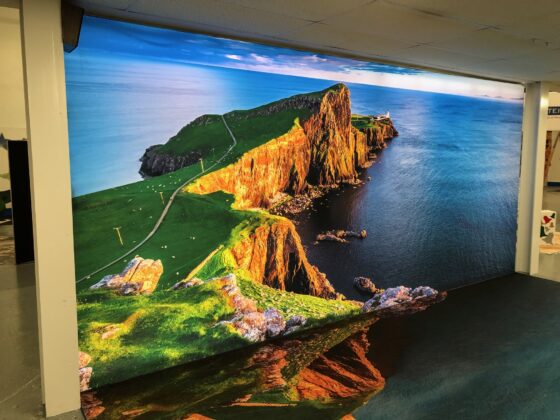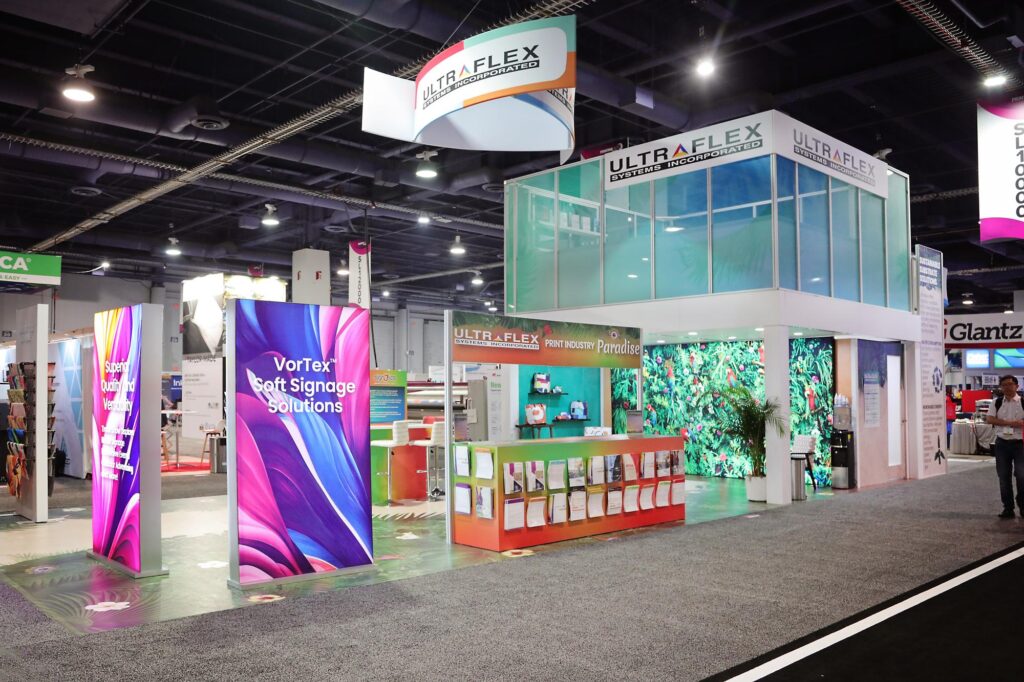
Silicone edge graphics, usually shortened to SEG, are printed fabric panels finished with a thin silicone bead sewn to every edge. That bead tucks into a narrow groove milled into an aluminum frame, pulling the print drum-tight and hiding the frame edge behind the image. The result is the clean, frameless, glare-free look that has taken over retail walls, trade show booths, and backlit light boxes. For a print service provider, the frame is the easy part. The finished quality of an SEG panel lives almost entirely in the textile you choose and how you print it.
This guide is written for print and sign shops that already sell wide-format work and want to spec SEG fabric correctly the first time. It covers how the system works, how to match a textile to front-lit or backlit use, the opacity, stretch and width details that separate a crisp panel from a wrinkled one, which press each fabric belongs on, and the flame-resistance document the venue will ask for.
Key Takeaways
- SEG panels are printed textiles with a silicone bead sewn to the edge that seats into a grooved aluminum frame, giving a taut, frameless, glass-free face.
- The frame is a commodity. Panel quality depends on the fabric’s opacity, weave, stretch and width, so spec the textile first.
- Front-lit SEG needs opacity to hide the frame and block light bleed. Backlit SEG needs a translucent, light-diffusing fabric that works at shallow installation depths.
- Match the fabric to your press. UltraFlex splits VorTex by process: D Line for direct dye-sublimation, T Line for dye-sub transfer, S Line for UV and Latex.
- Flame-resistance listings differ fabric by fabric. Triple White D251 lists NFPA 701, ASTM E84 and Title 19/CA 1237; Backlit Prism S155 lists Title 19/CA 1237. Pull the certificate for the exact roll you print.
What silicone edge graphics are, and why the fabric does the work
Dye-sublimation printing, the process behind most SEG panels, sits inside a market that Smithers values at $10.51 billion in 2023 and projects will reach $15.2 billion by 2029 at a 7.9 percent compound annual growth rate, with printed volumes climbing toward 2.9 billion square meters (WhatTheyThink). SEG is one of the visible faces of that growth, and it is a format buyers increasingly ask for by name.
Mechanically, an SEG panel is simple. A shop prints an image on a polyester textile, then a finisher sews a flexible silicone strip, sometimes called a keder or a gasket, around the perimeter. On site, an installer presses that strip into a recessed channel in an extruded aluminum frame. The tension pulls every wrinkle out and the frame face disappears behind the graphic. Because there is no glass or acrylic, there is no glare and no reflection, which is why SEG replaced so many rigid framed prints in stores and showrooms.
That construction is exactly why material choice is the whole game. The frame is an off-the-shelf extrusion. What the customer sees is your printed textile, stretched flat and lit either from the front or from behind. Choose a fabric with too little opacity and the frame shadows or the light box hotspots show through. Choose one with the wrong stretch and the panel either sags or refuses to seat. Everything downstream of the print starts with picking the right cloth.
Match the fabric to the lighting: front-lit versus backlit
Signage and textile work already anchor a large share of wide-format businesses. In the FESPA 2023 Print Census, which surveyed 1,778 printers and signmakers across more than 120 countries, respondents named signage as the focus of 26 percent of businesses and textile as the focus of 24 percent (FESPA). SEG lives right where those two categories meet, and the first fork in any SEG job is whether the panel is lit from the front or the back.
Front-lit SEG is the default: a graphic on a wall, a room divider, or a booth face lit by ambient or spot lighting. Here you want opacity. VorTex™ Triple White D251 is a 7.4 oz/yd² fabric whose tight weave creates a smooth surface, and UltraFlex rates it as offering greater opacity than other products of similar weight, which is why the product page calls it an excellent fit for SEG frames and pop-up displays. That opacity keeps the aluminum frame from ghosting through the image and stops light from bleeding through a thin panel. It is also one of the few in the line UltraFlex lists as suitable for both front-lit and back-lit fabric applications.
A true light box changes the requirement completely. The fabric now has to transmit and spread light evenly without showing the LEDs behind it. That calls for a translucent, high-diffusion textile such as VorTex™ Backlit Prism S155, a 4.6 oz bright-white polyester UltraFlex describes as highly translucent with superior light diffusion at low installation depths. Shallow depth is the detail that matters: the less room the LEDs have to blend, the more the diffusion rating does the work.
One trap here catches dye-sub shops. Backlit Prism S155 is an S Line product, compatible with UV and Latex inks only, so it will not run on a dye-sub press. If dye-sub is your line, the backlit answer is a different product. VorTex™ Backlit Optimum D270 is a woven fabric with a satin finish and a light diffusion layer built to illuminate without pinholes, and it runs on dye-sub direct, dye-sub transfer, UV and Latex. VorTex™ Backlit Precision T130 is a transfer product coated to resist color distortion where the fabric creases, which is worth having on a panel that gets folded between shows. Compare the options across the full backlit media range before you quote, because a front-lit fabric dropped into a light box will almost always hotspot.
Opacity, stretch, and width: the three specs that decide the panel
Three properties account for most of the SEG panels that come back. Opacity comes from weave and weight: a tighter weave hides the frame and resists light bleed, and heavier fabrics generally block more light. Stretch is the second. A knit with a little give, such as VorTex™ Heavy D340, a 10.03 oz/yd² 100 percent polyester knit with moderate opacity and slight stretch, seats cleanly into a frame and is listed for backdrops, SEG displays, table throws and pop-up displays. Too much stretch, though, distorts fine type and logos as the panel is tensioned, so proof real artwork on a sample before committing a run.
Width is the third, and it is the one that quietly sets your cost. A panel wider than your roll needs a seam, and a seam across a retail wall is the defect a client notices from across the room. Roll width varies more across the VorTex line than most buyers expect, and the widest fabric in this group is a backlit one.
Seam planning
Maximum roll width, VorTex fabrics used for SEG
How wide a panel you can print in one piece, before a seam crosses the image.
VorTex Backlit Prism S155
200″
VorTex Grand Display D223
198″
VorTex Triple White D251
126″
VorTex Heavy D340
126″
VorTex™ Grand Display D223 is the front-lit answer for oversized work: a 6.5 oz tight knit, crease-free, listed for displays and roll-up and pop-up displays, and available in widths from 63 to 198 inches. Triple White D251 and Heavy D340 top out at 126 inches, which covers most booth faces and retail panels but not a full-height wall run. Backlit Prism S155 spans 63 to 200 inches, so the light box, not the front-lit wall, is where you have the most room before a seam. Wrinkle resistance rounds out the list: a wrinkle-resistant fabric like Heavy D340 ships folded and recovers flat, which keeps returns down when a customer opens the box the morning of an event. Compare weights, widths and finishes across the full VorTex Soft Signage line.
Print process: dye-sub, UV, or latex for SEG fabric
The print process is not a detail you settle last. Smithers notes that dye-sublimation gives polyester fabrics high lightfastness, good washfastness and superior abrasion resistance, which is why it dominates soft signage (WhatTheyThink). But not every shop runs a dye-sub line, and the right fabric depends on the press you already own.
UltraFlex groups its VorTex textiles by print process, which makes the match straightforward. The D Line is built for direct dye-sublimation, where you print onto the textile and fix the ink in a calender or oven. The T Line is made for dye-sub transfer, where the image goes onto transfer paper first and is then pressed into the cloth. The S Line is the answer for shops without a dye-sub press, built for UV and Latex, with several products also rated for solvent and eco-solvent. The lines are not sealed off from each other: Triple White D251 is listed for direct dye-sub, transfer, Latex and UV, which lets a mixed-equipment shop route a job to whichever press is open. Heavy D340 is narrower in scope, rated for dye-sub direct, UV and Latex but not transfer.
The practical rule: confirm the fabric’s rated process before you quote, not after the roll arrives. Running a transfer-only textile on a latex printer, or forcing a UV fabric through a calender, wastes media and misses the finish the customer expects. When you are unsure, pull the numbers from the technical data sheets rather than guessing from feel.
Flame resistance: get the listing before you quote, not before install
Convention centers and many retail landlords require documented flame resistance before a graphic goes up. The two standards you will be asked for most often are NFPA 701, a vertical flame test, and ASTM E84, a surface burning test. California venues frequently reference Title 19 instead.
The listings differ fabric by fabric, which is the part that trips shops up. Within the four VorTex fabrics in this guide, Triple White D251 lists NFPA 701, ASTM E84 and Title 19/CA 1237. Grand Display D223 lists NFPA 701 and Title 19/CA 1237. Heavy D340 lists NFPA 701 and Title 19/California. Backlit Prism S155 lists Title 19/CA 1237. If your booth is going into a venue that asks for NFPA 701 in writing, that difference decides which backlit fabric you can use.
UltraFlex publishes the listings on each product page and collects the documents on its Fire Certificates page. Pull the certificate for the exact fabric you are printing, keep it with the job, and hand it to the venue. Do not promise a rating you have not read.
Where SEG wins: retail, events, and reusable displays
Live events keep SEG demand steady. The US Bureau of Labor Statistics counts 172,100 meeting, convention and event planners employed in 2025 and projects 6 percent growth from 2025 to 2035, faster than the average across all occupations (BLS). Every one of those trade shows and conferences is a buyer of booth walls, backdrops and hanging signs, and SEG has become the default because the panels ship light, pack flat and reuse well.
Reusability is the argument you pass to the client. A dye-sub SEG graphic rolls or folds into a small box, travels as textile rather than rigid board, and reseats into the same frame show after show. When the campaign changes, the customer reprints one fabric panel and keeps the frame, which lowers the lifetime cost of the display against replacing rigid panels. For the display side of these formats, see the guides on the tension fabric display and on choosing a banner and soft signage supplier for trade show graphics. If the panel will be printed by dye-sublimation, the dye sublimation fabric buyer’s guide covers the press-side decisions in more detail.
A quick SEG spec checklist for print providers
Before you order fabric for a silicone edge graphics job, confirm these six points:
- Lighting. Front-lit or backlit. This single answer rules most of the fabric list in or out.
- Opacity. For front-lit panels, is the weave tight and opaque enough to hide the frame and block light bleed?
- Stretch. Does the fabric have enough give to seat cleanly, but not so much that it distorts type under tension?
- Width. Can you cover the panel in one piece, or does the job need a seam? 126 inches covers most booth faces; 198 to 200 inches covers oversized work.
- Print process. Is the fabric rated for your press: direct dye-sub, transfer, UV, or Latex?
- Flame listing. Does the certificate for that exact fabric carry the standard the venue named?
If you can answer all six, you can quote an SEG job with confidence. When a customer’s project is new to you, the fastest way to de-risk it is to print a proof on real material. Request a sample of any VorTex textile and run your own artwork before you commit a full order, or contact UltraFlex in Randolph, New Jersey to talk the spec through with someone who knows the line.
Frequently Asked Questions
What is the difference between silicone edge graphics and a regular tension fabric display?
They overlap. Silicone edge graphics refers specifically to the finishing method, a silicone bead sewn to the fabric edge that locks into a grooved aluminum frame for a taut, frameless face. Tension fabric display is a broader term that also covers pillowcase-style graphics that slip over a tube frame. SEG gives the tightest, flattest, most edge-to-edge result.
Do I need a dye-sublimation printer to make SEG panels?
No. UltraFlex splits its VorTex textiles by print process, and the S Line is made for shops without a dye-sub press. VorTex Backlit Prism S155, for example, is compatible with UV and Latex inks. Several D Line fabrics also accept UV and Latex, so a mixed-equipment shop has options on both sides of the catalog.
Which fabric should I use for a backlit SEG light box?
Use a translucent, high-diffusion textile rather than an opaque front-lit fabric. VorTex Backlit Prism S155 is a 4.6 oz bright-white backlit polyester that UltraFlex describes as highly translucent with superior light diffusion at low installation depths, which matters in a shallow light box. Match it to your press first: S155 runs on UV and Latex, while VorTex Backlit Optimum D270 covers direct dye-sublimation and VorTex Backlit Precision T130 covers dye-sub transfer.
Why does my SEG panel show wrinkles or a shadow of the frame?
A visible frame shadow usually means the fabric is not opaque enough for a front-lit application, so move to a tighter, more opaque weave. Persistent wrinkles often point to a fabric with little wrinkle recovery, or a panel cut slightly small so it cannot tension fully. Confirm both the material and the finished panel dimensions before reprinting.
What flame-resistance listings do UltraFlex SEG fabrics carry?
It varies by fabric, which is why you check per product rather than per brand. VorTex Triple White D251 lists NFPA 701, ASTM E84 and Title 19/CA 1237. VorTex Heavy D340 lists NFPA 701 and Title 19/California. VorTex Backlit Prism S155 lists Title 19/CA 1237. Every listing is published on the product page and on the Fire Certificates page, so pull the document for the exact fabric you are printing.