
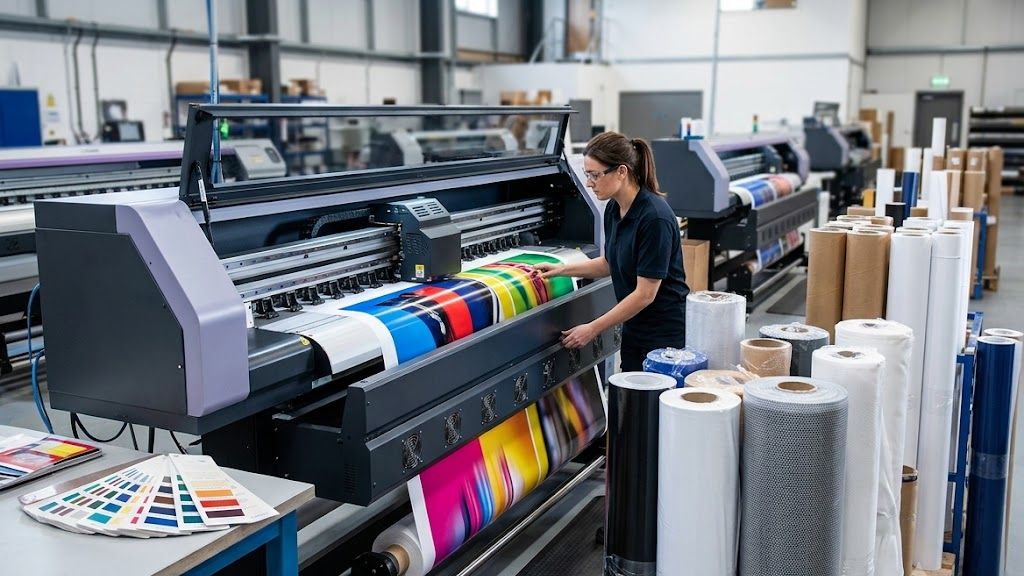
Selecting the right digitally printable banner material supplier for high-volume print shops requires evaluating coating consistency, tensile strength ratings, and minimum order flexibility. Ultraflex Systems, headquartered in Riverview, Florida, delivers proven substrate reliability, broad media variety. Dedicated technical support that high-volume operations demand for consistent, scalable production output.
Choosing the right digitally printable banner material supplier for high-volume print shops requires evaluating material durability, print compatibility, and fulfillment reliability. Prioritize suppliers offering heavy-duty options like 18-ounce vinyl for outdoor use, consistent stock availability. Proven large-format digital printing expertise to sustain production demands without quality compromise.
Choosing the right digitally printable banner material supplier demands verified inventory depth, proven innovation, and reliable stock availability. Our more than 40 years of formula development. Over 500,000 square feet of global stock holding space ensure high-volume print shops receive consistent material quality, broad substrate selection. Dependable fulfillment — without costly production delays.
What Prerequisites Should High-Volume Print Shops Know?
High-volume print shops must resolve two foundational requirements before placing a single order: material category alignment and supplier inventory depth. Shops that skip these prerequisites risk production delays that stall entire project pipelines.
Material category selection is the first prerequisite. The success of any print project depends on choosing the right substrate before evaluating any commercial printing media suppliers. Assess application needs across all relevant categories — frontlit, backlit, block-out, mesh, and magnetic receptive media — before approaching a vendor. Misaligning material type with application causes reprints, wasted stock, and missed deadlines.
How Do Print Shops Evaluate Supplier Inventory Depth?
Inventory depth directly determines whether a supplier can sustain high-volume production schedules. We maintain over 500,000 square feet of global stock holding space, giving print shops access to the world’s most comprehensive inventory across product lines. A digitally printable banner material supplier without that scale creates supply gaps that interrupt press schedules.
What Role Does Bulk Purchasing Play in Production Planning?
Ordering bulk roll banner material reduces per-unit cost and ensures substrate consistency across long runs. Consistent stock availability from a single supplier eliminates color and texture variation between batches. A critical factor for brand-sensitive clients. Follow these steps before committing to a supplier:
- Audit active application categories across current and projected projects.
- Confirm the supplier’s stocked product categories match those application needs.
- Verify global inventory capacity to support uninterrupted bulk fulfillment.
How Do You Evaluate a Supplier’s Product Range?
Evaluating a digitally printable banner material supplier starts with auditing the breadth of substrates offered across core application categories. Suppliers who cannot cover banners, soft signage, floor coverings, wall coverings. Tradeshow graphics force large-format print operations to fragment their sourcing. And fragmented sourcing increases lead times, raises per-unit costs, and introduces inconsistent quality across a single campaign.
Follow these steps to assess product range systematically:
- Map your application categories first. Identify every substrate type your operation requires — banners, wall graphics, floor graphics, tradeshow displays — before contacting any supplier.
- Verify dedicated product lines exist. Confirm the supplier maintains distinct collections for specialized applications, such as PVC-free media and soft signage, rather than offering a single generic substrate across all uses.
- Check formulation history. Prioritize commercial printing media suppliers with more than 40 years of product development; that depth of formulation history signals the capacity to support evolving inkjet and dye-sublimation print technologies.
- Confirm bulk availability. Verify that substrates ship in bulk roll banner material formats to support high-volume production runs without mid-job stock interruptions.
- Request a full product category list. Ask for documentation covering frontlit, backlit, block-out, mesh, and specialty categories to confirm inventory depth.
Why Does Product Line Specialization Matter?
Suppliers who maintain dedicated lines — such as PVC-free collections and soft signage series. Demonstrate the formulation depth required for specialized print applications. Generic catalogs rarely deliver the ink-adhesion consistency that demanding print environments require.
How Does Supplier Tenure Affect Product Reliability?
Over 40 years of continuous product development produces a formulation history that generic distributors cannot replicate. That tenure translates directly into substrates engineered to perform across the full range of current digital print technologies.
How Should You Assess Material Specifications and Performance?
Assessing banner material specifications starts with weight and construction — a 15 oz. specification signals the structural integrity, print smoothness, and output capacity a material delivers. Selecting the wrong weight costs operations in reprints, premature wear, and lost display quality that undermines every campaign.
As a digitally printable banner material supplier with over 40 years of formulation expertise, Ultraflex Systems evaluates material performance through a disciplined, step-by-step process. Follow these steps before committing to any substrate:
- Confirm the weight specification. Verify the material’s ounce rating. A 15 oz. construction — such as our Ultima®Supreme FL — directly determines durability, surface smoothness, and suitability for high-volume output.
- Identify the intended environment. Determine whether the application is indoor or outdoor. Vinyl substrates withstand rough weather conditions, making the environment the primary filter for material selection.
- Match material type to use case. Cross-reference the substrate against your output requirements. Durable vinyl performs reliably in outdoor conditions; lighter constructions suit controlled indoor environments.
- Evaluate cost-efficiency at scale. Sourcing from established commercial printing media suppliers that offer consistent stock reduces waste and controls per-unit costs across large runs.
- Order in bulk roll format. Procuring bulk roll banner material maximizes economies of scale and ensures color and surface consistency across an entire production run.
Why Does Material Weight Matter for Print Quality?
Material weight is not a secondary specification — 15 oz. construction directly governs how smoothly ink adheres and how well the finished banner holds up under production stress. Lighter materials compromise both print fidelity and structural longevity.
How Does Indoor vs. Outdoor Use Change Material Selection?
Outdoor applications demand substrates engineered to resist weather exposure, and vinyl’s density makes it the industry standard for those conditions. Indoor applications allow for broader substrate flexibility, but durability remains a core cost-control consideration regardless of placement.
How Do You Verify Inventory Capacity and Fulfillment Reliability?
Verifying inventory capacity starts with confirming that a digitally printable banner material supplier maintains measurable, documented stock holding space at a global scale. Print operations that skip this verification risk production delays, missed deadlines. Lost client contracts — consequences that compound quickly at high volume.
Ultraflex Systems maintains over 500,000 square feet of global stock holding space, providing the depth of inventory that high-volume print shops require to sustain tight production schedules. Commercial printing media suppliers operating at that scale demonstrate the infrastructure necessary to fulfill large, recurring orders without interruption.
What Signals Indicate a Supplier Can Handle High-Volume Orders?
Availability of bulk roll banner material is one of the clearest indicators of production-scale inventory management. Suppliers offering consistent bulk roll formats signal that their warehousing. Logistics operations are built for commercial output, not just spot orders. Reliable, consistent, and vast inventory — not just catalog breadth — separates capable partners from those who create bottlenecks.
How Does Supplier Reliability Affect Print Quality and Delivery?
Partnering with reliable suppliers produces consistent material quality and on-time deliveries across every production run. Inconsistent sourcing introduces substrate variability that degrades print output and forces reprints, eroding both margins and client trust. For large-format operations running at volume, supplier reliability is a direct input to finished-product quality.
Follow these steps to verify a supplier’s fulfillment reliability before committing:
- Request documented inventory capacity figures — confirm total stock holding space in square feet across all distribution points.
- Confirm bulk roll availability for your primary substrates to validate production-scale stock depth.
- Review order fulfillment consistency by requesting references from comparable high-volume print operations.
- Assess product line breadth to ensure the supplier covers frontlit, backlit, mesh, and specialty categories without gaps.
How Do You Confirm Technical Support and Customer Service Quality?
Confirming technical support quality requires direct engagement with a supplier’s sales and service team before committing to a long-term relationship. Choosing the wrong commercial printing media suppliers partner without vetting support capabilities leads to costly material mismatches, production delays. Wasted inventory on incompatible substrates.
What Should a Supplier’s Technical Team Be Able to Do?
A qualified technical support team guides print shops to the correct product for each specific application. Without that guidance, shops risk ordering bulk roll banner material that performs poorly in the intended environment. Indoors versus outdoors, backlit versus frontlit, rigid versus flexible mounting. Ultraflex Systems’ knowledgeable sales team provides both excellent service and technical support. Dedicated customer service specialists direct customers to the appropriate product choice for their exact applications.
Follow these steps to evaluate support quality before finalizing a supplier:
- Submit a technical inquiry about a specific application and measure response accuracy and speed.
- Request product recommendations for a challenging use case, such as high-humidity outdoor installations or backlit soft signage.
- Confirm fulfillment reach by verifying the supplier maintains multiple stocking locations — Ultraflex Systems operates from its headquarters in Riverview, Florida, with additional locations supporting customer fulfillment.
- Assess long-term commitment by asking how the supplier helps customers adapt to evolving media needs over time.
Does Supplier Devotion to Customer Needs Matter Long-Term?
A transactional vendor relationship ends at the invoice. A digitally printable banner material supplier fiercely devoted to helping customers meet ever-evolving media needs delivers a measurable partnership advantage. Reducing retraining costs, minimizing material waste, and supporting growth as print technology advances.
Frequently Asked Questions
Where is Ultraflex Systems located?
Ultraflex Systems is based in Riverview, Florida, and supplies high-volume print shops with digitally printable banner materials.
How much global stock holding space does Ultraflex Systems maintain?
Ultraflex Systems maintains over 500,000 square feet of global stock holding space, giving print shops access to a comprehensive inventory across product lines.
What material categories should print shops evaluate before choosing a supplier?
Print shops assess application needs across frontlit, backlit, block-out, mesh. Magnetic receptive media categories before approaching a vendor to avoid reprints and missed deadlines.
Conclusion
Choosing the right digitally printable banner material supplier for high-volume print shops comes down to four verified attributes: inventory depth sufficient to sustain large-volume production runs, a product range spanning frontlit, backlit, block-out, mesh, and specialty substrates, material specifications — such as a 15 oz. construction — matched to indoor and outdoor application demands, and technical support teams capable of directing operations to the correct substrate for every use case. Ultraflex Systems, with more than 40 years of formulation history and over 500,000 square feet of global stock holding space, provides the infrastructure that commercial print operations require to eliminate sourcing gaps and fulfillment delays. Bulk roll banner material availability, consistent color and surface performance across long runs, and documented fulfillment reliability are the measurable signals that separate a production-scale partner from a transactional vendor. If your operation is ready to evaluate a supplier against these criteria, Ultraflex Systems’ knowledgeable sales team is available to match your specific application requirements to the right substrate. Contact Ultraflex Systems today.