Printable fabric is polyester or poly-blend textile engineered to accept a graphic through dye-sublimation, UV, latex, or solvent printing, and it now anchors most of the soft signage a print shop sells: tension displays, silicone edge graphics (SEG), backlit boxes, flags, table throws, and wallcoverings. For print service providers weighing whether to add it alongside vinyl, the short answer is that fabric wins on weight, packability, wrinkle recovery, image depth, and PVC-free options, while vinyl still wins on hard outdoor durability. This guide walks through the substrate families, the ink and printer question, venue fire codes, and a practical way to spec each job.
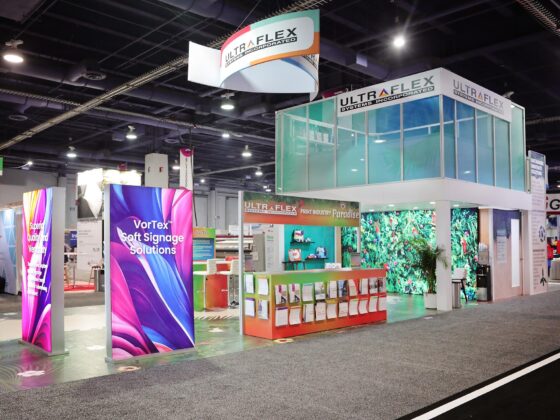
UltraFlex Systems has manufactured and stocked print media for more than 40 years, with over 500,000 square feet of global stock holding space, and its VorTex Soft Signage line alone spans 36 fabrics. That range is the reason “printable fabric” is not one decision but several, and getting the match right is what separates a clean install from a callback.
Key Takeaways
- Printable fabric is a polyester or poly-blend textile made for dye-sublimation, UV, latex, or solvent printing, used for tension displays, SEG, backlit graphics, flags, and wallcoverings.
- The three UltraFlex fabric lines map to how you print: the D Line is direct dye-sublimation, the T Line is dye-sublimation transfer, and the S Line prints on UV and latex machines you may already own.
- Fabric is lighter and foldable, so it ships cheaper and sets up faster than PVC banner, and wrinkles relax under tension in an SEG frame.
- Fire listings are held per product, not per line. UltraFlex publishes each one on its Fire Certificates page, so check the exact fabric before you quote.
- PVC-free, recycled-content, and formaldehyde-free options let you answer sustainability requirements without giving up print quality.
What is printable fabric and how is it different from vinyl?
Printable fabric is a woven or knitted textile, almost always 100 percent polyester or a poly-blend, treated with a coating so ink sits crisply on the surface. Compared with a PVC scrim banner, fabric is lighter and folds instead of rolling, so a booth graphic that once shipped in a tube now ships flat in a box. It recovers from creases, and in a tensioned frame those creases disappear entirely. Dye-sublimation drives the color into the fibers rather than laying it on top, which produces deep saturation and a matte finish that photographs without glare.
The trade-offs are honest. PVC vinyl still leads for multi-year outdoor exposure and abrasion, while fabric is built for indoor and short-term outdoor use. UltraFlex covers both categories, so the choice is about the application, not the brand.
Which printable fabric should you use for each application?
In-store and event graphics remain a steady book of business for print shops. E-commerce accounted for 17.1 percent of total US retail sales in the second quarter of 2026 according to the US Census Bureau, which leaves the large majority of retail spending happening in physical stores that still need graphics on their walls, windows, and fixtures. The substrate you pick depends on the fixture it hangs in.
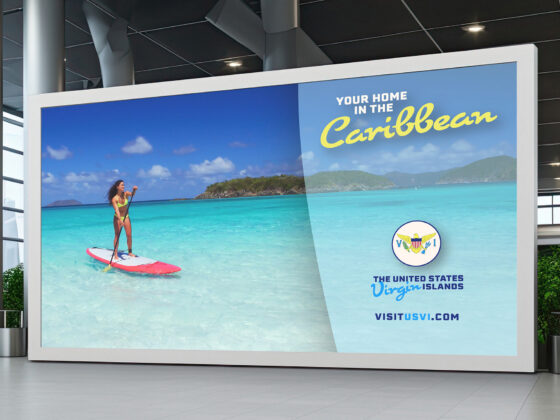
- Tension displays and SEG frames. Reach for a smooth, opaque knit. VorTex Triple White D251 has a tight weave and greater opacity than other products of similar weight, so it suits SEG frames and pop-up displays and works front-lit or back-lit. VorTex Heavy D340 is a knitted fabric with moderate opacity and a slight stretch for easy installation on backdrops, SEG displays, table throws, and pop-ups, and it is wrinkle-resistant and fire-resistant.
- Backlit light boxes. You want translucency and even diffusion. VorTex Backlit Prism S155 is a 4.6 ounce bright-white polyester that is highly translucent with superior light diffusion and low installation depth, while VorTex Backlit Optimum D270 uses a satin finish and a light-diffusion layer for uniform illumination without pinholes. Both live in the broader backlit media category.
- Blockout and double-sided. When light bleed is the enemy, VorTex Stretch Eclipse D250 is a 7.37 ounce soft blockout with a black back and a slight stretch, and VorTex Blockout D252 uses a white, black, white triple-layer construction that makes it almost completely opaque.
- Flags and feather banners. VorTex Flag D110 is a 100 percent polyester knitted fabric with excellent wind flow, fire-resistant, for banners, feather flags, and theatrical backdrops.
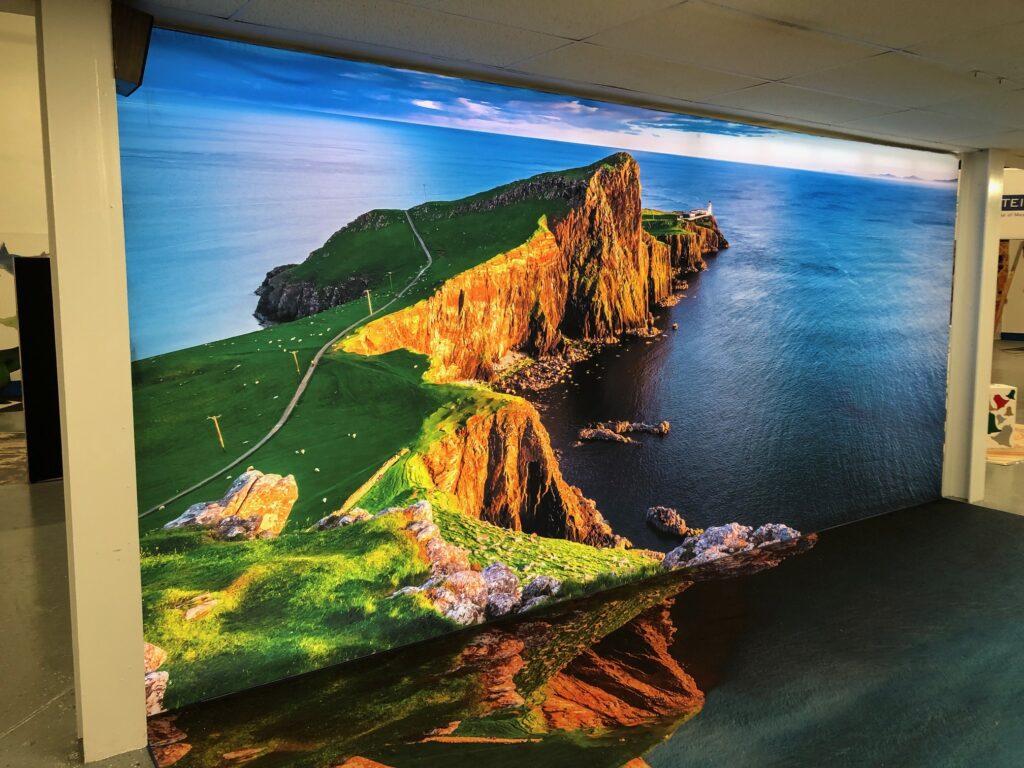
- Wallcoverings. Wallscapes XL is a durable wallcovering available in 126 and 196 inch widths to cut seam count and installation time, and Wallscapes EcoVantage Plus is a PVC-free option. Browse the full wallcovering media range for finishes.
Spec check
Maximum roll width, by fabric
Width is what decides whether a large wall or backdrop prints as one piece or arrives as panels to seam. Check it against your printer and your finishing table before you quote.
VorTex Backlit Prism S155
200 in
VorTex Grand Display D223
198 in
Wallscapes XL
196 in
VorTex Backlit S181
196 in
VorTex Bolero S225
126 in
VorTex Heavy D340
126 in
What inks and printers work with printable fabric?
The single most important spec question is which printer will run the job, because printable fabric is grouped by process, not just by look. UltraFlex organizes its VorTex line into three families that map directly to your equipment.
The D Line is treated for direct dye-sublimation, where you print onto the fabric and heat-set it, and many D Line fabrics also accept latex and UV: VorTex Backlit Optimum D270, for instance, is print compatible with dye-sub direct, dye-sub transfer, UV, and latex. The T Line is built for dye-sublimation transfer, where you print onto transfer paper first and then marry it to the fabric under heat and pressure, which is how VorTex Backlit Event T202 is run. The S Line is the one to look at if you have no dye-sublimation setup. VorTex Backlit Prism S155 and VorTex Backlit S181 are compatible with UV and latex, and VorTex Bolero S225 adds solvent and eco-solvent, so you can add fabric graphics on presses you already own. Check the ink compatibility on the individual product before you commit, because it varies inside each line.
Width is the other gate. Many UltraFlex fabrics run 126 inches, and the widest reach further: VorTex Grand Display D223 goes to 198 inches and VorTex Backlit Prism S155 to 200 inches, which lets a large backdrop print as one piece rather than panels you have to seam. The technical data sheets list ink compatibility, weight, and width for every product.
Do printable fabrics meet fire and safety codes for venues?
Convention centers, hotels, and retail landlords almost always require flame-resistant graphics. The listings that come up most often in North America are NFPA 701, a vertical-flame test for textiles and films, ASTM E 84, the surface-burning test that yields a Class A, B, or C rating, and California Title 19, which many venues name directly.
The point print providers miss is that these listings are held per product, not per line, and UltraFlex publishes them product by product on its Fire Certificates page. Among the textiles listed there, VorTex Bolero S225, VorTex Backlit S181, VorTex Stretch Eclipse D250, VorTex Grand Display D223, VorTex Flag D110, VorTex Soft Stretch D221 and VorTex Backlit Optimum D270 carry NFPA 701/286. VorTex Backlit Prism S155 is listed to Title 19/CA 1237. VorTex Backlit Event T202 holds NFPA 701 and Title 19/CA 1237. On the wallcovering side, Wallscapes EcoVantage Plus passes ASTM E 84 with a Class A rating, and Wallscapes XL is listed to ASTM E 84.
So the practical workflow is short. Before you quote an event graphic, ask the venue which certification the fire marshal requires, then check that exact fabric on the Fire Certificates page and keep the matching document with the job file. That one step avoids the worst outcome in event work, which is a finished graphic rejected at the loading dock on install day.
How does printable fabric support sustainability goals?
Plastic waste is a real procurement concern for brands. The US Environmental Protection Agency reports that about 146.1 million tons of municipal solid waste were landfilled in 2018, that plastics accounted for over 18 percent of it, and that the national recycling and composting rate was 32.1 percent. Many corporate buyers now ask their print vendors for PVC-free or recycled options in writing.
Printable fabric answers that in several ways. VorTex Backlit S181 is PVC-free, phthalate-free, crease resistant, and can be recycled under code number 1 (PET). VorTex Backlit Event T202 is a woven polyester made with 10 percent recycled yarns. Wallscapes EcoVantage Plus is PVC-free and formaldehyde-free, with no phthalates, heavy metals, or PFA materials, and it can replace PVC and olefin-laminated products. Beyond the material itself, fabric is reusable: a tension graphic folds into a case, travels to the next show, and comes back out without the curl and cracking that retires a vinyl banner, so the same print does more work before it is replaced. UltraFlex documents its low-impact substrates on its sustainability page.
How should a print provider spec and order printable fabric?
The out-of-home graphics market is healthy, reaching a record 9.46 billion dollars in 2025, up 3.6 percent year over year, per the Out of Home Advertising Association of America, so demand for well-specified display graphics is not the constraint. Getting the spec right is.
Work the job in this order. First, define the fixture and lighting: SEG frame, backlit box, flag, or wall. Second, match the fabric family to your printer using the D, T, and S Line logic above, then confirm ink compatibility on the individual product page. Third, confirm width against your printer and finishing equipment. Fourth, check the fire listing the venue needs against that exact fabric. Fifth, order a sample and run a test print before you buy a full roll, because color and hand vary between fabrics and your profile needs a real target. You can request a sample or request a quote directly from UltraFlex to lock the spec before production.
Frequently Asked Questions
Is printable fabric better than vinyl for banners?
It depends on the environment. Fabric is lighter, folds flat for cheaper shipping, resists wrinkles, and offers PVC-free choices, which makes it the better pick for indoor displays, trade shows, and short-term outdoor use. PVC vinyl still leads for long-term outdoor exposure and abrasion resistance.
Can you print photographic images on fabric?
Yes. Dye-sublimation drives ink into the polyester fibers, producing deep, saturated color and a matte, glare-free finish that reproduces photography and gradients well, which is why backlit and retail graphics so often use fabric.
Do I need a dye-sublimation printer to run printable fabric?
No. UltraFlex S Line fabrics are made for printers a shop is likely to own already. VorTex Backlit Prism S155 and VorTex Backlit S181 run on UV and latex, and VorTex Bolero S225 adds solvent and eco-solvent. Dye-sublimation, direct or transfer, is one route, not the only one.
Is printable fabric washable and reusable?
Tension and SEG fabrics are designed to fold into a case, travel, and re-tension without permanent creasing, so a single graphic can serve multiple events. Follow the specific product’s care guidance, since washability varies by fabric.
Is printable fabric fire-rated for events?
Fire listings are held per product, not per line. UltraFlex publishes them on its Fire Certificates page: VorTex Bolero S225, VorTex Backlit S181, VorTex Grand Display D223, VorTex Flag D110 and VorTex Stretch Eclipse D250 are listed to NFPA 701/286, while VorTex Backlit Prism S155 is listed to Title 19/CA 1237. Wallscapes EcoVantage Plus passes ASTM E 84 with a Class A rating. Check the specific product against the certification your venue asks for.