soft signage

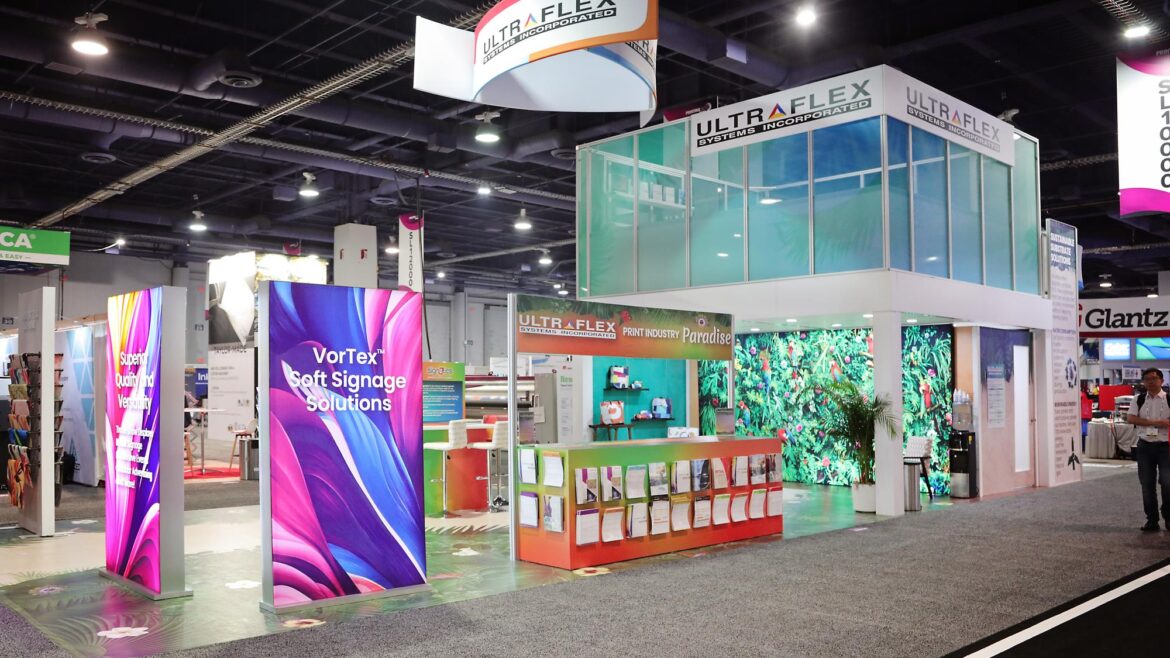
UltraFlex Systems trade show booth at PRINTING United, with backlit and front-lit VorTex soft signage SEG panels in aluminum frames

Silicone Edge Graphics: A Print Provider’s Material Guide

Silicone Edge Graphics: A Print Provider’s Material Guide 2000 1333 Howell Studios

Silicone edge graphics, usually shortened to SEG, are printed fabric panels finished with a thin silicone bead sewn to every edge. That bead tucks into a narrow groove milled into an aluminum frame, pulling the print drum-tight and hiding the frame edge behind the image. The result is the clean, frameless, glare-free look that has taken over retail walls, trade show booths, and backlit light boxes. For a print service provider, the frame is the easy part. The finished quality of an SEG panel lives almost entirely in the textile you choose and how you print it.

This guide is written for print and sign shops that already sell wide-format work and want to spec SEG fabric correctly the first time. It covers how the system works, how to match a textile to front-lit or backlit use, the opacity, stretch and width details that separate a crisp panel from a wrinkled one, which press each fabric belongs on, and the flame-resistance document the venue will ask for.

Key Takeaways

  • SEG panels are printed textiles with a silicone bead sewn to the edge that seats into a grooved aluminum frame, giving a taut, frameless, glass-free face.
  • The frame is a commodity. Panel quality depends on the fabric’s opacity, weave, stretch and width, so spec the textile first.
  • Front-lit SEG needs opacity to hide the frame and block light bleed. Backlit SEG needs a translucent, light-diffusing fabric that works at shallow installation depths.
  • Match the fabric to your press. UltraFlex splits VorTex by process: D Line for direct dye-sublimation, T Line for dye-sub transfer, S Line for UV and Latex.
  • Flame-resistance listings differ fabric by fabric. Triple White D251 lists NFPA 701, ASTM E84 and Title 19/CA 1237; Backlit Prism S155 lists Title 19/CA 1237. Pull the certificate for the exact roll you print.

What silicone edge graphics are, and why the fabric does the work

Dye-sublimation printing, the process behind most SEG panels, sits inside a market that Smithers values at $10.51 billion in 2023 and projects will reach $15.2 billion by 2029 at a 7.9 percent compound annual growth rate, with printed volumes climbing toward 2.9 billion square meters (WhatTheyThink). SEG is one of the visible faces of that growth, and it is a format buyers increasingly ask for by name.

Mechanically, an SEG panel is simple. A shop prints an image on a polyester textile, then a finisher sews a flexible silicone strip, sometimes called a keder or a gasket, around the perimeter. On site, an installer presses that strip into a recessed channel in an extruded aluminum frame. The tension pulls every wrinkle out and the frame face disappears behind the graphic. Because there is no glass or acrylic, there is no glare and no reflection, which is why SEG replaced so many rigid framed prints in stores and showrooms.

That construction is exactly why material choice is the whole game. The frame is an off-the-shelf extrusion. What the customer sees is your printed textile, stretched flat and lit either from the front or from behind. Choose a fabric with too little opacity and the frame shadows or the light box hotspots show through. Choose one with the wrong stretch and the panel either sags or refuses to seat. Everything downstream of the print starts with picking the right cloth.

Match the fabric to the lighting: front-lit versus backlit

Signage and textile work already anchor a large share of wide-format businesses. In the FESPA 2023 Print Census, which surveyed 1,778 printers and signmakers across more than 120 countries, respondents named signage as the focus of 26 percent of businesses and textile as the focus of 24 percent (FESPA). SEG lives right where those two categories meet, and the first fork in any SEG job is whether the panel is lit from the front or the back.

Front-lit SEG is the default: a graphic on a wall, a room divider, or a booth face lit by ambient or spot lighting. Here you want opacity. VorTex™ Triple White D251 is a 7.4 oz/yd² fabric whose tight weave creates a smooth surface, and UltraFlex rates it as offering greater opacity than other products of similar weight, which is why the product page calls it an excellent fit for SEG frames and pop-up displays. That opacity keeps the aluminum frame from ghosting through the image and stops light from bleeding through a thin panel. It is also one of the few in the line UltraFlex lists as suitable for both front-lit and back-lit fabric applications.

A true light box changes the requirement completely. The fabric now has to transmit and spread light evenly without showing the LEDs behind it. That calls for a translucent, high-diffusion textile such as VorTex™ Backlit Prism S155, a 4.6 oz bright-white polyester UltraFlex describes as highly translucent with superior light diffusion at low installation depths. Shallow depth is the detail that matters: the less room the LEDs have to blend, the more the diffusion rating does the work.

One trap here catches dye-sub shops. Backlit Prism S155 is an S Line product, compatible with UV and Latex inks only, so it will not run on a dye-sub press. If dye-sub is your line, the backlit answer is a different product. VorTex™ Backlit Optimum D270 is a woven fabric with a satin finish and a light diffusion layer built to illuminate without pinholes, and it runs on dye-sub direct, dye-sub transfer, UV and Latex. VorTex™ Backlit Precision T130 is a transfer product coated to resist color distortion where the fabric creases, which is worth having on a panel that gets folded between shows. Compare the options across the full backlit media range before you quote, because a front-lit fabric dropped into a light box will almost always hotspot.

Opacity, stretch, and width: the three specs that decide the panel

Three properties account for most of the SEG panels that come back. Opacity comes from weave and weight: a tighter weave hides the frame and resists light bleed, and heavier fabrics generally block more light. Stretch is the second. A knit with a little give, such as VorTex™ Heavy D340, a 10.03 oz/yd² 100 percent polyester knit with moderate opacity and slight stretch, seats cleanly into a frame and is listed for backdrops, SEG displays, table throws and pop-up displays. Too much stretch, though, distorts fine type and logos as the panel is tensioned, so proof real artwork on a sample before committing a run.

Width is the third, and it is the one that quietly sets your cost. A panel wider than your roll needs a seam, and a seam across a retail wall is the defect a client notices from across the room. Roll width varies more across the VorTex line than most buyers expect, and the widest fabric in this group is a backlit one.

Seam planning

Maximum roll width, VorTex fabrics used for SEG

How wide a panel you can print in one piece, before a seam crosses the image.

VorTex Backlit Prism S155

200″

VorTex Grand Display D223

198″

VorTex Triple White D251

126″

VorTex Heavy D340

126″

Source: UltraFlex Systems product pages, read 29 September 2026. Widths are the top of each product’s stated range.

VorTex™ Grand Display D223 is the front-lit answer for oversized work: a 6.5 oz tight knit, crease-free, listed for displays and roll-up and pop-up displays, and available in widths from 63 to 198 inches. Triple White D251 and Heavy D340 top out at 126 inches, which covers most booth faces and retail panels but not a full-height wall run. Backlit Prism S155 spans 63 to 200 inches, so the light box, not the front-lit wall, is where you have the most room before a seam. Wrinkle resistance rounds out the list: a wrinkle-resistant fabric like Heavy D340 ships folded and recovers flat, which keeps returns down when a customer opens the box the morning of an event. Compare weights, widths and finishes across the full VorTex Soft Signage line.

Print process: dye-sub, UV, or latex for SEG fabric

The print process is not a detail you settle last. Smithers notes that dye-sublimation gives polyester fabrics high lightfastness, good washfastness and superior abrasion resistance, which is why it dominates soft signage (WhatTheyThink). But not every shop runs a dye-sub line, and the right fabric depends on the press you already own.

UltraFlex groups its VorTex textiles by print process, which makes the match straightforward. The D Line is built for direct dye-sublimation, where you print onto the textile and fix the ink in a calender or oven. The T Line is made for dye-sub transfer, where the image goes onto transfer paper first and is then pressed into the cloth. The S Line is the answer for shops without a dye-sub press, built for UV and Latex, with several products also rated for solvent and eco-solvent. The lines are not sealed off from each other: Triple White D251 is listed for direct dye-sub, transfer, Latex and UV, which lets a mixed-equipment shop route a job to whichever press is open. Heavy D340 is narrower in scope, rated for dye-sub direct, UV and Latex but not transfer.

The practical rule: confirm the fabric’s rated process before you quote, not after the roll arrives. Running a transfer-only textile on a latex printer, or forcing a UV fabric through a calender, wastes media and misses the finish the customer expects. When you are unsure, pull the numbers from the technical data sheets rather than guessing from feel.

Flame resistance: get the listing before you quote, not before install

Convention centers and many retail landlords require documented flame resistance before a graphic goes up. The two standards you will be asked for most often are NFPA 701, a vertical flame test, and ASTM E84, a surface burning test. California venues frequently reference Title 19 instead.

The listings differ fabric by fabric, which is the part that trips shops up. Within the four VorTex fabrics in this guide, Triple White D251 lists NFPA 701, ASTM E84 and Title 19/CA 1237. Grand Display D223 lists NFPA 701 and Title 19/CA 1237. Heavy D340 lists NFPA 701 and Title 19/California. Backlit Prism S155 lists Title 19/CA 1237. If your booth is going into a venue that asks for NFPA 701 in writing, that difference decides which backlit fabric you can use.

UltraFlex publishes the listings on each product page and collects the documents on its Fire Certificates page. Pull the certificate for the exact fabric you are printing, keep it with the job, and hand it to the venue. Do not promise a rating you have not read.

Where SEG wins: retail, events, and reusable displays

Live events keep SEG demand steady. The US Bureau of Labor Statistics counts 172,100 meeting, convention and event planners employed in 2025 and projects 6 percent growth from 2025 to 2035, faster than the average across all occupations (BLS). Every one of those trade shows and conferences is a buyer of booth walls, backdrops and hanging signs, and SEG has become the default because the panels ship light, pack flat and reuse well.

Reusability is the argument you pass to the client. A dye-sub SEG graphic rolls or folds into a small box, travels as textile rather than rigid board, and reseats into the same frame show after show. When the campaign changes, the customer reprints one fabric panel and keeps the frame, which lowers the lifetime cost of the display against replacing rigid panels. For the display side of these formats, see the guides on the tension fabric display and on choosing a banner and soft signage supplier for trade show graphics. If the panel will be printed by dye-sublimation, the dye sublimation fabric buyer’s guide covers the press-side decisions in more detail.

A quick SEG spec checklist for print providers

Before you order fabric for a silicone edge graphics job, confirm these six points:

  • Lighting. Front-lit or backlit. This single answer rules most of the fabric list in or out.
  • Opacity. For front-lit panels, is the weave tight and opaque enough to hide the frame and block light bleed?
  • Stretch. Does the fabric have enough give to seat cleanly, but not so much that it distorts type under tension?
  • Width. Can you cover the panel in one piece, or does the job need a seam? 126 inches covers most booth faces; 198 to 200 inches covers oversized work.
  • Print process. Is the fabric rated for your press: direct dye-sub, transfer, UV, or Latex?
  • Flame listing. Does the certificate for that exact fabric carry the standard the venue named?

If you can answer all six, you can quote an SEG job with confidence. When a customer’s project is new to you, the fastest way to de-risk it is to print a proof on real material. Request a sample of any VorTex textile and run your own artwork before you commit a full order, or contact UltraFlex in Randolph, New Jersey to talk the spec through with someone who knows the line.

Frequently Asked Questions

What is the difference between silicone edge graphics and a regular tension fabric display?
They overlap. Silicone edge graphics refers specifically to the finishing method, a silicone bead sewn to the fabric edge that locks into a grooved aluminum frame for a taut, frameless face. Tension fabric display is a broader term that also covers pillowcase-style graphics that slip over a tube frame. SEG gives the tightest, flattest, most edge-to-edge result.

Do I need a dye-sublimation printer to make SEG panels?
No. UltraFlex splits its VorTex textiles by print process, and the S Line is made for shops without a dye-sub press. VorTex Backlit Prism S155, for example, is compatible with UV and Latex inks. Several D Line fabrics also accept UV and Latex, so a mixed-equipment shop has options on both sides of the catalog.

Which fabric should I use for a backlit SEG light box?
Use a translucent, high-diffusion textile rather than an opaque front-lit fabric. VorTex Backlit Prism S155 is a 4.6 oz bright-white backlit polyester that UltraFlex describes as highly translucent with superior light diffusion at low installation depths, which matters in a shallow light box. Match it to your press first: S155 runs on UV and Latex, while VorTex Backlit Optimum D270 covers direct dye-sublimation and VorTex Backlit Precision T130 covers dye-sub transfer.

Why does my SEG panel show wrinkles or a shadow of the frame?
A visible frame shadow usually means the fabric is not opaque enough for a front-lit application, so move to a tighter, more opaque weave. Persistent wrinkles often point to a fabric with little wrinkle recovery, or a panel cut slightly small so it cannot tension fully. Confirm both the material and the finished panel dimensions before reprinting.

What flame-resistance listings do UltraFlex SEG fabrics carry?
It varies by fabric, which is why you check per product rather than per brand. VorTex Triple White D251 lists NFPA 701, ASTM E84 and Title 19/CA 1237. VorTex Heavy D340 lists NFPA 701 and Title 19/California. VorTex Backlit Prism S155 lists Title 19/CA 1237. Every listing is published on the product page and on the Fire Certificates page, so pull the document for the exact fabric you are printing.
VorTex Stretch Eclipse D250 dye sublimation fabric graphic installed in a shopping mall

Dye Sublimation Fabric: A Buyer’s Guide for Printers

Dye Sublimation Fabric: A Buyer’s Guide for Printers 2160 1342 Howell Studios

Dye sublimation fabric is the stock behind most modern soft signage: retail displays, trade show booths, backlit light boxes and tension frame graphics. It prints bright, ships folded instead of rolled, and carries no PVC. The catch is that the fabrics are not interchangeable. Buy one your press cannot run, or one that stops 70 inches short of your finished width, and you have bought a reprint you cannot bill. This guide walks the four checks a print provider actually makes before ordering a roll, using the published specs on UltraFlex’s own product pages.

Key takeaways

  • Check the line before anything else. In the VorTex™ Soft Signage range, 24 of the 35 fabrics run dye sublimation. All ten S Line fabrics are UV, latex and solvent only.
  • D Line fabrics take direct dye sublimation, T Line fabrics take transfer. Sixteen fabrics accept both, so one roll can cover either workflow.
  • Then spec weight (3.24 to 10.03 oz/yd²), opacity (single layer versus a white-black-white blockout), stretch (rigid weave versus knit for silicone edge graphics) and width.
  • Width is the trap. Most of these fabrics top out at 126 inches. One reaches 198.
  • Fire listings are held per product, not per range. Read the certificate for the exact fabric before you quote a regulated venue.

How Dye Sublimation Puts the Image Inside the Cloth

Dye sublimation fabric is a polyester or polyester-blend textile made to receive disperse dyes under heat and pressure. The solid dye turns straight to a gas, the polymer chains in the polyester open, and the dye moves into the fiber before it cools and sets. The color ends up inside the material rather than sitting on the surface, so it does not crack, peel or change the hand of the cloth.

That is also why the process holds up in the field. Smithers reports that dye-sublimated polyester carries high lightfastness, good washfastness and better abrasion resistance than silk and other delicate fabrics (Smithers, via WhatTheyThink, April 2025). For a print provider that means graphics that survive shipping, repeated installs and years of retail lighting.

The market underneath it is not small. The same Smithers analysis put global dye sublimation print at $10.51 billion, forecast to reach $15.2 billion by 2029 on a 7.9% compound annual growth rate. Garments are the largest segment; display and signage work is a smaller share of that total, which is worth knowing when you read a headline number. On the shop side, the 2023 FESPA Print Census found 1,778 printers and sign makers across more than 120 countries defining their business focus as graphics (61%), signage (26%), textile (24%) and industrial (14%) (FESPA).

The practical pull is simpler than the market data. A fabric graphic weighs a fraction of a vinyl banner, folds into a box instead of a tube, and comes out wrinkle-resistant. It is non-reflective under display lighting. It contains no PVC, which takes the disposal question off the table. UltraFlex holds this category in its VorTex™ Soft Signage range, supplied to the United States, Canada and Latin America from its Riverview, Florida headquarters and five North American warehouses.

Check One: The Line Has to Match Your Press

This is the check that costs the most when it is skipped, so make it first. UltraFlex splits VorTex Soft Signage into three lines, and only two of them are dye sublimation stock.

  • D Line — 18 fabrics, built for direct dye sublimation. You print the dye straight onto the fabric on a textile printer and fix it with heat in one pass. Seventeen of the 18 accept direct dye sublimation; the exception, ReSource™ Eclipse® D260, is a UV and latex fabric sitting in the same line.
  • T Line — 7 fabrics, coated for transfer. You print a mirrored image onto sublimation paper, then marry paper to fabric in a heat calender. All seven are transfer fabrics; none of them takes direct dye sublimation.
  • S Line — 10 fabrics, and none of them is dye sublimation stock. Every S Line product is coated for UV and latex, and several add solvent and eco-solvent. VorTex™ Backlit Prism S155 is a good example: a 4.6 oz bright-white backlit textile that goes to 200 inches wide, listed for UV and latex only. It is an excellent backlit fabric and the wrong thing to load for a dye sublimation job.

Sixteen fabrics in the range accept both direct and transfer dye sublimation, which is the useful middle ground. If you run a calender now and expect to buy a textile printer later, those sixteen let you change method without changing stock. The printability list on each product page is the authority; check it rather than inferring from the letter in the product code.

What the range actually holds

Four numbers to check before you order a roll

Counted off the published specs of every fabric in the VorTex Soft Signage range.

24 of 35

fabrics run dye sublimation. The ten S Line fabrics are UV, latex and solvent only.

16

accept both direct and transfer, so one roll covers either workflow

3.24–10.03

oz/yd² weight span, from the Flag D110 to the Heavy D340 and T340

1

dye sublimation fabric reaches 198 in. Most of the rest stop at 126.

Source: UltraFlex VorTex Soft Signage product pages (35 fabrics — 18 D Line, 10 S Line, 7 T Line — plus the VorTex Clear Gasket), read 28 September 2026.

Checks Two to Four: Weight, Opacity and Stretch

Once the line is right, three material properties decide the job.

  • Weight, in oz/yd². The dye sublimation fabrics in this range run from 3.24 oz to 10.03 oz. Light fabrics drape and move: VorTex™ Flag D110 is a 3.24 oz knit with good wind flow, listed for banners, feather flags and theatrical backdrops. Heavy fabrics hold tension flat and resist creasing: VorTex™ Heavy D340 is a 10.03 oz knit for backdrops, SEG displays, table throws and pop-ups. In the middle, VorTex™ Grand Display D223 is a 6.5 oz tight knit that UltraFlex lists as crease-free for roll-up and pop-up displays.
  • Opacity. A single-layer fabric is fine for single-sided and backlit work. Light from behind or from an odd angle needs a blockout. VorTex™ Blockout D252 is an 8.26 oz woven with a white-black-white triple-layer construction that UltraFlex describes as almost completely opaque. For a softer hand, VorTex™ Stretch Eclipse® D250 is a 7.37 oz black-back blockout with slight stretch, and VorTex™ Triple White D251 is a 7.4 oz tight weave that carries more opacity than other fabrics of similar weight, for both front-lit and back-lit use.
  • Stretch. Silicone edge graphics have to seat into an extrusion without pulling. VorTex™ Soft Stretch D221 is a 6.48 oz knit that UltraFlex lists as more opaque than comparable stretch products, which is what hides frame and tubing structures behind the graphic. VorTex™ Super Stretch D231 is the 9.17 oz version, and UltraFlex notes it is geared toward an experienced printer. VorTex™ Stretch D235 is a poly-spandex knit where you need more give again.

Width is the fourth number and the one that quietly breaks jobs. Across this range 126 inches is the normal maximum. Grand Display D223 is the only dye sublimation fabric here that goes to 198 inches; Stretch Eclipse D250 and ReSource Eclipse D260 reach 196. So if the finished graphic is a 14-foot booth wall in one piece, the fabric choice is effectively made for you before you get to weight or opacity. Work the other way and you will be designing a seam you did not want.

Order a sample and run a test target before you commit a full roll. Opacity and color response differ between knits and wovens, and between direct and transfer on the same fabric.

Matching the Fabric to the Display

  • Silicone edge graphics and tension frames. Use a stretch knit, and finish it with the VorTex™ Clear Gasket, a 14 mm x 3 mm PVC gasket with an integrated sewing line, supplied in boxes of five 164-foot spools. Our companion guide on choosing the right tension fabric covers the frame side of the decision.
  • Backlit light boxes. You want a built-in diffusion layer, not just a light fabric. VorTex™ Backlit LX D300 is an 8.84 oz knit with a brushed backside and a diffusion layer for uniform illumination; VorTex™ Backlit Optimum D270 is a 7.96 oz satin-finish woven with the same feature. Both take direct and transfer dye sublimation. If your backlit work runs UV or latex instead, that is where the S Line belongs, and our backlit media guide covers the film options.
  • Double-sided banners and hanging signs. Use a blockout so the reverse image does not ghost. Stretch Eclipse D250 gives you a black back with enough stretch to install easily; Blockout D252 is the harder, more opaque option.
  • Flags and fence graphics. Flag D110 at 3.24 oz handles indoor and short-term outdoor work. VorTex™ Fence Mesh D150 is a 4.42 oz polyester mesh that UltraFlex positions as a fabric alternative to traditional PVC mesh, for fence graphics, outdoor banners and flying banners.
  • Transfer-only shops. If everything you run goes through a calender, the T Line is your catalogue. VorTex™ Soft Stretch T222 is the 6.48 oz knit and VorTex™ Heavy T340 the 10.03 oz one.

Start from the display and work back to the fabric. A booth backdrop, a retail SEG panel and an outdoor flag all print well on dye sublimation fabric, and each one wants a different weight, opacity and construction.

Fire Listings Are Held Per Product, Not Per Range

Trade shows, retail centers and public venues ask for a specific listing, and a range-level claim will not satisfy an inspector. Of the 24 dye sublimation fabrics in the VorTex Soft Signage range, the published product pages show 20 listing NFPA 701, nine listing a California Title 19 or CA 1237 rating, three listing Canada ULC, and two listing ASTM E84 — Super Stretch D231 and Triple White D251. Four fabrics show no published fire listing at all: Stretch D235, Silverback Flag D150, BioFlex® Cotton D280 and ReSource™ Backlit Event T202.

The gaps matter as much as the listings. If a venue names ASTM E84, only two fabrics here answer it. If it names Canada ULC, you are choosing between Flag D110, Blockout D252 and Backlit LX D300. Pull the certificate for the exact product from the UltraFlex fire certificates page, or the Fire Certificates download on the product page itself, and put that document in the job file before you quote.

Recycled and PVC-Free Dye Sublimation Fabric

Recycled content is now a line item on requests for quote rather than a nice-to-have. In the FESPA census, 70% of respondents said they can address sustainability demands without raising prices, and a further 22% had already raised prices without an effect on sales (FESPA). Polyester soft signage helps because it contains no PVC and the process uses water-based disperse dyes rather than solvent chemistry.

For a verified claim you need a standard behind it. The Textile Exchange Global Recycled Standard covers products with at least 20% recycled material and verifies the chain of custody behind the claim (Textile Exchange). UltraFlex’s ReSource™ substrates are made with GRS-certified recycled yarns, and several are dye sublimation stock: ReSource™ Glacier D310 is a 9 oz 100% GRS-certified recycled polyester soft blockout, and ReSource™ Star Eclipse® D270 is the 7.6 oz version. Note that ReSource™ Eclipse® D260, despite the D code, is UV and latex only. If you are fielding recycled-content questions on banner jobs as well, our recycled banner material guide covers how those options are specified.

Frequently Asked Questions

What fabric is used for dye sublimation?
Polyester and high-polyester blends. Disperse dyes bond only to polyester fibers, so the higher the polyester content, the brighter and more permanent the result. The VorTex dye sublimation fabrics are 100% polyester or polyester blends made for the process; the cotton and canvas products in the wider range are not dye sublimation stock.

What is the difference between direct and transfer dye sublimation fabric?
Direct fabrics print on a textile printer and fix in one heat pass. Transfer fabrics print onto sublimation paper first, then bond to the fabric in a heat calender. In the VorTex range, 17 fabrics take direct, 23 take transfer, and 16 take both. Choose the line that matches the press you already run.

How wide does dye sublimation fabric come?
In this range, most fabrics top out at 126 inches. VorTex Grand Display D223 goes to 198 inches, and Stretch Eclipse D250 and ReSource Eclipse D260 reach 196. Match the roll width to the finished graphic first, because it narrows the choice more than any other spec.

Is dye sublimation fabric fire resistant?
It depends on the product, not the range. Twenty of the 24 dye sublimation fabrics in the VorTex Soft Signage range list NFPA 701 on their product page, two list ASTM E84, three list Canada ULC and nine list a California Title 19 or CA 1237 rating. Four list none. Confirm the certificate for the exact fabric before you quote a regulated venue.

Is dye sublimation fabric better than vinyl?
For soft signage it is usually the easier product to ship and install: lighter, foldable, non-reflective and PVC-free. Vinyl still holds long-term outdoor and structural banner work, where a coated fabric is not the right substrate. The answer is set by the application, not by the material.

Can I print dye sublimation on an S Line fabric?
No. All ten S Line fabrics are listed for UV and latex, and several for solvent and eco-solvent. They are not coated for dye sublimation. If your press is a dye sublimation printer or a calender, buy from the D Line or the T Line.

To spec a fabric for a specific job, compare the published weight, width, printability and fire listing on each product page in the VorTex™ Soft Signage range, then request a sample and print a test target on your own press before committing a roll. If you are not sure which line matches your equipment, UltraFlex customer service can narrow it down first.

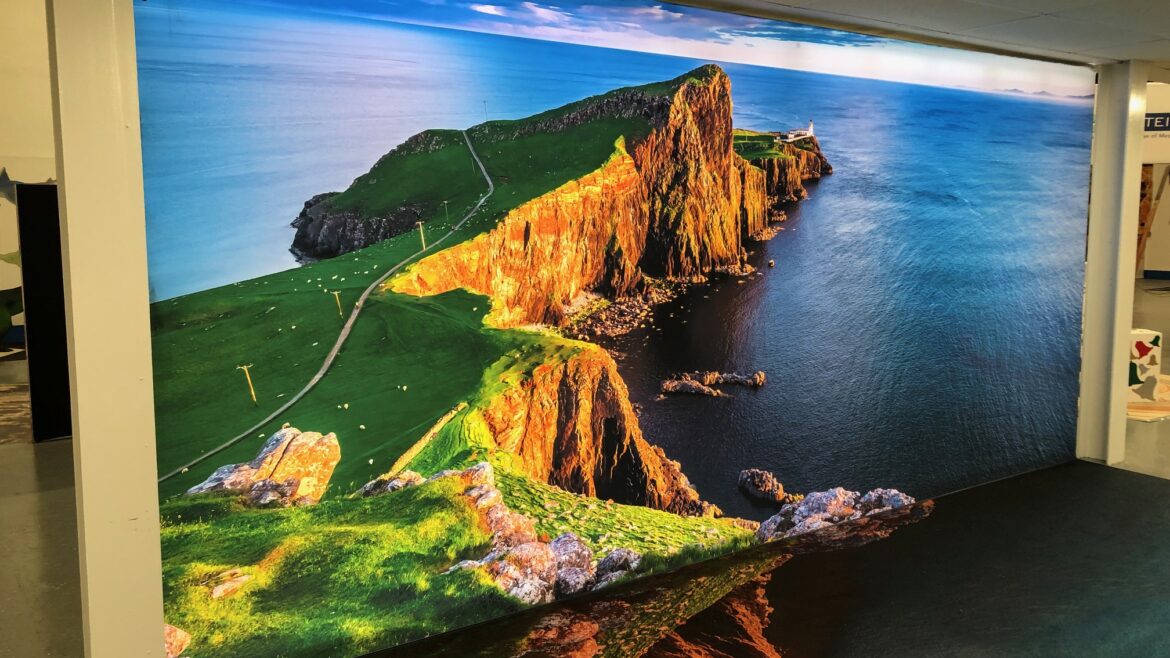
Large printed VorTex BLD300 soft signage fabric wall graphic of a coastal cliff installed in an interior space

Printable Fabric: A Print Provider’s Guide to Soft Signage

Printable Fabric: A Print Provider’s Guide to Soft Signage 2016 1512 Howell Studios

Printable fabric is polyester or poly-blend textile engineered to accept a graphic through dye-sublimation, UV, latex, or solvent printing, and it now anchors most of the soft signage a print shop sells: tension displays, silicone edge graphics (SEG), backlit boxes, flags, table throws, and wallcoverings. For print service providers weighing whether to add it alongside vinyl, the short answer is that fabric wins on weight, packability, wrinkle recovery, image depth, and PVC-free options, while vinyl still wins on hard outdoor durability. This guide walks through the substrate families, the ink and printer question, venue fire codes, and a practical way to spec each job.

UltraFlex Systems has manufactured and stocked print media for more than 40 years, with over 500,000 square feet of global stock holding space, and its VorTex Soft Signage line alone spans 36 fabrics. That range is the reason “printable fabric” is not one decision but several, and getting the match right is what separates a clean install from a callback.

Key Takeaways

  • Printable fabric is a polyester or poly-blend textile made for dye-sublimation, UV, latex, or solvent printing, used for tension displays, SEG, backlit graphics, flags, and wallcoverings.
  • The three UltraFlex fabric lines map to how you print: the D Line is direct dye-sublimation, the T Line is dye-sublimation transfer, and the S Line prints on UV and latex machines you may already own.
  • Fabric is lighter and foldable, so it ships cheaper and sets up faster than PVC banner, and wrinkles relax under tension in an SEG frame.
  • Fire listings are held per product, not per line. UltraFlex publishes each one on its Fire Certificates page, so check the exact fabric before you quote.
  • PVC-free, recycled-content, and formaldehyde-free options let you answer sustainability requirements without giving up print quality.

What is printable fabric and how is it different from vinyl?

Printable fabric is a woven or knitted textile, almost always 100 percent polyester or a poly-blend, treated with a coating so ink sits crisply on the surface. Compared with a PVC scrim banner, fabric is lighter and folds instead of rolling, so a booth graphic that once shipped in a tube now ships flat in a box. It recovers from creases, and in a tensioned frame those creases disappear entirely. Dye-sublimation drives the color into the fibers rather than laying it on top, which produces deep saturation and a matte finish that photographs without glare.

The trade-offs are honest. PVC vinyl still leads for multi-year outdoor exposure and abrasion, while fabric is built for indoor and short-term outdoor use. UltraFlex covers both categories, so the choice is about the application, not the brand.

Which printable fabric should you use for each application?

In-store and event graphics remain a steady book of business for print shops. E-commerce accounted for 17.1 percent of total US retail sales in the second quarter of 2026 according to the US Census Bureau, which leaves the large majority of retail spending happening in physical stores that still need graphics on their walls, windows, and fixtures. The substrate you pick depends on the fixture it hangs in.

  • Tension displays and SEG frames. Reach for a smooth, opaque knit. VorTex Triple White D251 has a tight weave and greater opacity than other products of similar weight, so it suits SEG frames and pop-up displays and works front-lit or back-lit. VorTex Heavy D340 is a knitted fabric with moderate opacity and a slight stretch for easy installation on backdrops, SEG displays, table throws, and pop-ups, and it is wrinkle-resistant and fire-resistant.
  • Backlit light boxes. You want translucency and even diffusion. VorTex Backlit Prism S155 is a 4.6 ounce bright-white polyester that is highly translucent with superior light diffusion and low installation depth, while VorTex Backlit Optimum D270 uses a satin finish and a light-diffusion layer for uniform illumination without pinholes. Both live in the broader backlit media category.
  • Blockout and double-sided. When light bleed is the enemy, VorTex Stretch Eclipse D250 is a 7.37 ounce soft blockout with a black back and a slight stretch, and VorTex Blockout D252 uses a white, black, white triple-layer construction that makes it almost completely opaque.
  • Flags and feather banners. VorTex Flag D110 is a 100 percent polyester knitted fabric with excellent wind flow, fire-resistant, for banners, feather flags, and theatrical backdrops.
  • Wallcoverings. Wallscapes XL is a durable wallcovering available in 126 and 196 inch widths to cut seam count and installation time, and Wallscapes EcoVantage Plus is a PVC-free option. Browse the full wallcovering media range for finishes.

Spec check

Maximum roll width, by fabric

Width is what decides whether a large wall or backdrop prints as one piece or arrives as panels to seam. Check it against your printer and your finishing table before you quote.

VorTex Backlit Prism S155

200 in

VorTex Grand Display D223

198 in

Wallscapes XL

196 in

VorTex Backlit S181

196 in

VorTex Bolero S225

126 in

VorTex Heavy D340

126 in

Source: UltraFlex Systems product pages, read 27 September 2026. Widest width published for each product.

What inks and printers work with printable fabric?

The single most important spec question is which printer will run the job, because printable fabric is grouped by process, not just by look. UltraFlex organizes its VorTex line into three families that map directly to your equipment.

The D Line is treated for direct dye-sublimation, where you print onto the fabric and heat-set it, and many D Line fabrics also accept latex and UV: VorTex Backlit Optimum D270, for instance, is print compatible with dye-sub direct, dye-sub transfer, UV, and latex. The T Line is built for dye-sublimation transfer, where you print onto transfer paper first and then marry it to the fabric under heat and pressure, which is how VorTex Backlit Event T202 is run. The S Line is the one to look at if you have no dye-sublimation setup. VorTex Backlit Prism S155 and VorTex Backlit S181 are compatible with UV and latex, and VorTex Bolero S225 adds solvent and eco-solvent, so you can add fabric graphics on presses you already own. Check the ink compatibility on the individual product before you commit, because it varies inside each line.

Width is the other gate. Many UltraFlex fabrics run 126 inches, and the widest reach further: VorTex Grand Display D223 goes to 198 inches and VorTex Backlit Prism S155 to 200 inches, which lets a large backdrop print as one piece rather than panels you have to seam. The technical data sheets list ink compatibility, weight, and width for every product.

Do printable fabrics meet fire and safety codes for venues?

Convention centers, hotels, and retail landlords almost always require flame-resistant graphics. The listings that come up most often in North America are NFPA 701, a vertical-flame test for textiles and films, ASTM E 84, the surface-burning test that yields a Class A, B, or C rating, and California Title 19, which many venues name directly.

The point print providers miss is that these listings are held per product, not per line, and UltraFlex publishes them product by product on its Fire Certificates page. Among the textiles listed there, VorTex Bolero S225, VorTex Backlit S181, VorTex Stretch Eclipse D250, VorTex Grand Display D223, VorTex Flag D110, VorTex Soft Stretch D221 and VorTex Backlit Optimum D270 carry NFPA 701/286. VorTex Backlit Prism S155 is listed to Title 19/CA 1237. VorTex Backlit Event T202 holds NFPA 701 and Title 19/CA 1237. On the wallcovering side, Wallscapes EcoVantage Plus passes ASTM E 84 with a Class A rating, and Wallscapes XL is listed to ASTM E 84.

So the practical workflow is short. Before you quote an event graphic, ask the venue which certification the fire marshal requires, then check that exact fabric on the Fire Certificates page and keep the matching document with the job file. That one step avoids the worst outcome in event work, which is a finished graphic rejected at the loading dock on install day.

How does printable fabric support sustainability goals?

Plastic waste is a real procurement concern for brands. The US Environmental Protection Agency reports that about 146.1 million tons of municipal solid waste were landfilled in 2018, that plastics accounted for over 18 percent of it, and that the national recycling and composting rate was 32.1 percent. Many corporate buyers now ask their print vendors for PVC-free or recycled options in writing.

Printable fabric answers that in several ways. VorTex Backlit S181 is PVC-free, phthalate-free, crease resistant, and can be recycled under code number 1 (PET). VorTex Backlit Event T202 is a woven polyester made with 10 percent recycled yarns. Wallscapes EcoVantage Plus is PVC-free and formaldehyde-free, with no phthalates, heavy metals, or PFA materials, and it can replace PVC and olefin-laminated products. Beyond the material itself, fabric is reusable: a tension graphic folds into a case, travels to the next show, and comes back out without the curl and cracking that retires a vinyl banner, so the same print does more work before it is replaced. UltraFlex documents its low-impact substrates on its sustainability page.

How should a print provider spec and order printable fabric?

The out-of-home graphics market is healthy, reaching a record 9.46 billion dollars in 2025, up 3.6 percent year over year, per the Out of Home Advertising Association of America, so demand for well-specified display graphics is not the constraint. Getting the spec right is.

Work the job in this order. First, define the fixture and lighting: SEG frame, backlit box, flag, or wall. Second, match the fabric family to your printer using the D, T, and S Line logic above, then confirm ink compatibility on the individual product page. Third, confirm width against your printer and finishing equipment. Fourth, check the fire listing the venue needs against that exact fabric. Fifth, order a sample and run a test print before you buy a full roll, because color and hand vary between fabrics and your profile needs a real target. You can request a sample or request a quote directly from UltraFlex to lock the spec before production.

Frequently Asked Questions

Is printable fabric better than vinyl for banners?
It depends on the environment. Fabric is lighter, folds flat for cheaper shipping, resists wrinkles, and offers PVC-free choices, which makes it the better pick for indoor displays, trade shows, and short-term outdoor use. PVC vinyl still leads for long-term outdoor exposure and abrasion resistance.

Can you print photographic images on fabric?
Yes. Dye-sublimation drives ink into the polyester fibers, producing deep, saturated color and a matte, glare-free finish that reproduces photography and gradients well, which is why backlit and retail graphics so often use fabric.

Do I need a dye-sublimation printer to run printable fabric?
No. UltraFlex S Line fabrics are made for printers a shop is likely to own already. VorTex Backlit Prism S155 and VorTex Backlit S181 run on UV and latex, and VorTex Bolero S225 adds solvent and eco-solvent. Dye-sublimation, direct or transfer, is one route, not the only one.

Is printable fabric washable and reusable?
Tension and SEG fabrics are designed to fold into a case, travel, and re-tension without permanent creasing, so a single graphic can serve multiple events. Follow the specific product’s care guidance, since washability varies by fabric.

Is printable fabric fire-rated for events?
Fire listings are held per product, not per line. UltraFlex publishes them on its Fire Certificates page: VorTex Bolero S225, VorTex Backlit S181, VorTex Grand Display D223, VorTex Flag D110 and VorTex Stretch Eclipse D250 are listed to NFPA 701/286, while VorTex Backlit Prism S155 is listed to Title 19/CA 1237. Wallscapes EcoVantage Plus passes ASTM E 84 with a Class A rating. Check the specific product against the certification your venue asks for.

From Tradeshow Graphics to Soft Signage: How the Right Banner Material Supplier Powers Every Application

Tension Fabric Displays: How to Choose the Right Fabric

Tension Fabric Displays: How to Choose the Right Fabric 1024 576 Howell Studios

A tension fabric display is a printed polyester fabric graphic stretched taut over a lightweight aluminum frame, held in place by a sewn silicone edge (SEG) or pole pockets. The frame gives it shape. The fabric decides whether it looks sharp on the show floor or sags, wrinkles, and shows the tubing underneath.

Most buying guides focus on the frame kits. This one focuses on the part that actually prints: the fabric. As a materials manufacturer that has supplied digitally printable textiles for over 40 years, UltraFlex Systems sees the same problem repeatedly. A print provider chooses a display system, then discovers the fabric was the variable that mattered most. Weight, opacity, stretch, print method, and fire rating separate a display that photographs well and lasts several seasons from one that gets remade after one event.

Key Takeaways

  • A tension fabric display stretches a dye-sublimated polyester fabric over an aluminum tube or extrusion frame, tensioned by a silicone edge graphic (SEG) or pole pockets.
  • The fabric, not the frame, drives image quality. Weight (measured in ounces), opacity, and knit construction determine whether the frame shows through and how the graphic drapes.
  • Opacity matters most on freestanding structures. A more opaque stretch fabric hides frame and tubing shadows that a thin fabric reveals.
  • Dye-sublimation printing gives the most vivid, wash-durable color on polyester, while latex and UV suit shorter runs and mixed shops.
  • Fire ratings are not optional. Most convention centers require fabric graphics to meet a recognized flame-resistance standard before they enter the hall.
  • PVC-free and recycled-content fabrics now cover most tension display applications, so sustainability rarely forces a quality trade-off.

What is a tension fabric display?

A tension fabric display is a graphic system that stretches a printed polyester fabric over a lightweight aluminum frame and holds it taut with a silicone edge strip or pole pockets. The tension removes wrinkles and creates a smooth, frameless graphic surface. Common formats include straight and curved backwalls, tension fabric backdrops, hanging structures, pillowcase-style banners, and tabletop displays.

The U.S. B2B exhibition industry has nearly rebuilt its pre-pandemic strength. In 2024, 37.0 percent of completed events surpassed their pre-pandemic performance, up 8 percentage points from 2023, according to the Center for Exhibition Industry Research (CEIR). That rebound keeps demand high for portable, reusable booth graphics. Tension fabric systems win here because one printed fabric skin packs into a soft case, installs without tools, and swaps out without replacing the frame.

The system has three parts: the aluminum frame (tube or extrusion), the printed fabric graphic, and the finishing that connects them (an SEG strip or sewn pole pockets). UltraFlex supplies the middle part, the printable textile, through its VorTex Soft Signage line. The frame and the print are only as good as the fabric between them.

Why fabric is replacing rigid and vinyl signage

Printed fabric is displacing rigid panels and PVC banners because it ships lighter, reuses across events, and prints as one clean piece at wide sizes. The market reflects the shift. The global dye-sublimation printing market is forecast to grow from about USD 16.85 billion in 2026 to USD 28.05 billion by 2031, a 10.72 percent compound annual growth rate (Mordor Intelligence). Two independent research firms put digital textile printing on a similar climb, both landing near a 13.8 percent CAGR through the mid-2030s (Precedence Research, Fortune Business Insights).

The practical wins are concrete. Fabric folds into a fraction of the freight volume of a boxed rigid display, which lowers shipping cost and shrinks the carbon footprint of every event.

Fabric also holds up to reuse. A dye-sublimated polyester graphic can be folded, shipped, and reinstalled repeatedly, and many fabrics are washable. There is no glare under booth lighting the way there is on laminated rigid signage. And because fabrics run wide, large graphics can be printed as a single piece with no seam. UltraFlex stocks VorTex soft signage fabrics in 126 inch widths, wide enough to cover most backwalls without a seam.

For a broader look at choosing print substrates, our guide on how to choose banner material covers the trade-offs across vinyl, mesh, and fabric.

The fabric decides whether the frame shows through

Opacity is the spec buyers underestimate most. VorTex Soft Stretch T222 is a 6.48 ounce knitted polyester fabric that is more opaque than comparable stretch products, which lets it hide the frame and tubing structures behind a tension display where a thinner fabric would reveal shadow lines. On a freestanding, front-lit backwall, that opacity is the difference between a clean graphic and one with the skeleton showing through.

Three fabric properties drive the result:

  • Weight. Heavier fabrics (measured in ounces per square yard) are more opaque and drape with more body. Lighter fabrics pack smaller and stretch more easily over curved frames.
  • Construction. A knitted fabric stretches in multiple directions, which is what lets a tension graphic pull drum-tight over a frame without puckering at the corners.
  • Drape and recovery. The fabric must stretch during installation and recover its shape without permanent distortion after repeated setups.
Fabric type Typical use What to prioritize
Light knit stretch Curved frames, tight-tension SEG backwalls Stretch and recovery
Opaque stretch (heavier) Freestanding front-lit backwalls Opacity to hide the frame
Backlit fabric Lightboxes and illuminated displays Even light diffusion
Soft drape textile Table throws, hanging banners Wrinkle resistance and hand feel

UltraFlex organizes its VorTex line into T, D, and S families so print providers can match construction to application. The VorTex T Line includes both the opaque Soft Stretch T222 for structural displays and lighter fabrics like VorTex Soft T230, a 100 percent polyester knit built for banners and table throws with a smooth print surface and soft drape.

Frontlit versus backlit tension fabric

Match the fabric to how the display is lit. A front-lit tension display, the standard trade show backwall, needs an opaque fabric that reads well under ambient and spotlighting. A backlit tension display, built into an illuminated lightbox, needs a fabric engineered to diffuse light evenly so the graphic glows without hot spots or visible lamps.

Using a front-lit fabric in a lightbox produces uneven brightness. Using a backlit fabric on a freestanding wall can let the frame show through. UltraFlex produces dedicated backlit soft signage such as VorTex Backlit Event T202 and VorTex Backlit LX D300 for illuminated builds, alongside its front-lit stretch fabrics. If your project involves illuminated graphics, our backlit film buyer’s guide explains the light-diffusion trade-offs in more detail.

Silicone edge graphics (SEG): how the fabric is finished

A silicone edge graphic is a fabric print with a thin silicone strip sewn around its perimeter that presses into a channel in the frame, producing a taut, frameless, edge-to-edge graphic. SEG is the finishing method behind most modern tension fabric displays and lightboxes because it hides the frame completely and lets graphics swap in seconds.

SEG puts real demand on the fabric. The material has to be dimensionally stable so the sewn silicone strip lines up with the frame groove after printing and finishing, and it has to hold tension without the print cracking at the fold. Dye-sublimated polyester handles this well because the color penetrates the fibers rather than sitting on the surface. Related formats such as fabric pop up displays and tension fabric banners rely on the same fabric behavior, just with different frames.

Dye-sublimation versus latex and UV printing

Choose the print method by run length, equipment, and durability. Dye-sublimation transfers dye into polyester fibers under heat, producing vivid, wash-durable color that will not crack when the fabric stretches. It is the standard for high-volume soft signage. Latex and UV printing put ink on the fabric surface and suit shorter runs or shops that print multiple substrates on one machine.

The practical answer for most providers is to stock fabrics that print more than one way. VorTex Soft Stretch T222 and VorTex Soft T230 are both compatible with UV, latex, solvent, eco-solvent, and screen printing in addition to dye-sublimation, so a shop can match the method to the job without changing media. Many UltraFlex fabrics are also HP Latex certified, which removes the guesswork from color profiling on latex hardware.

Fire ratings and exhibit-hall compliance

Fabric graphics that enter a convention center almost always have to meet a recognized flame-resistance standard, most often NFPA 701, the standard fire test for flame propagation of textiles and films, and show marshals can pull noncompliant displays from the floor. A missing fire certificate can cost an exhibitor the booth on setup day, so the fabric’s rating is a purchasing requirement, not an afterthought.

Verify two things before you buy: that the fabric itself carries a fire rating, and that the manufacturer can supply the certificate your venue asks for. UltraFlex VorTex fabrics, including the Soft Stretch T222 and Soft T230, are fire resistant, and the company publishes downloadable fire certificates so exhibitors can document compliance in advance.

Sustainable tension fabric options

Sustainability in a tension display is decided by the fabric, because the frame gets reused for years while the printed skin is the consumable. The material choice carries the footprint. Recycled polyester holds roughly 50 to 78 percent less embodied carbon than virgin polyester, about 0.68 to 1.56 versus 3.12 kilograms of CO2 equivalent per kilogram (Carbonfact). Printing on a recycled-content or PVC-free fabric is the most direct way to cut a display’s footprint without giving up performance.

UltraFlex offers PVC-free and recycled-content routes for tension displays. Its EcoVantage line is 100 percent PVC-free and phthalate-free, designed to be recycled or safely incinerated without releasing harmful toxins, with EcoVantage 190 recyclable under PET code number 1. Its ReSource line brings recycled content into soft signage fabrics such as ReSource Backlit Event T202 and ReSource Heavy D280. Both sit in the sustainable substrate range and print on standard equipment, so switching does not require new hardware.

Embodied carbon

Recycled polyester against virgin polyester

Kilograms of CO2 equivalent per kilogram of fabric.

Recycled polyester (low)0.68 kgRecycled polyester (high)1.56 kgVirgin polyester3.12 kg

Carbonfact: recycled polyester holds roughly 50 to 78 percent less embodied carbon than virgin polyester.

How to spec and order the right fabric

Work through five questions before you order, in this order:

  1. Lighting. Front-lit or backlit? This decides the fabric family first.
  2. Structure. Freestanding wall (prioritize opacity) or curved SEG frame (prioritize stretch)?
  3. Print method. Dye-sublimation, latex, or UV? Confirm the fabric supports your machine.
  4. Compliance. Which fire standard does the venue require, and can you get the certificate?
  5. Sustainability. Does the client need PVC-free or recycled content?

The fastest way to de-risk a fabric choice is to print a proof on the actual media. UltraFlex lets print providers request a sample of any VorTex fabric to test opacity, stretch, and color on their own hardware before committing to a full roll. For project-specific guidance, the team can be reached through the contact page or at (973) 627-8608.

Frequently Asked Questions

What is the difference between a tension fabric display and a pop-up display?

A tension fabric display stretches a single printed fabric skin over a rigid aluminum frame for a taut, seamless graphic. A pop-up display uses an accordion-style expanding frame with graphic panels attached to it. Many fabric pop up displays now use tension fabric skins, so the line between the two has blurred, but the defining feature of a tension fabric system is the drum-tight fabric held by an SEG strip or pole pockets.

What fabric is used for tension fabric displays?

Most tension fabric displays use dye-sublimated knitted polyester. For freestanding front-lit walls, an opaque stretch fabric such as a 6.48 ounce knit hides the frame. For backlit lightboxes, a light-diffusing backlit fabric is used. For table throws and hanging banners, a lighter soft-drape polyester works best.

Are tension fabric graphics washable and reusable?

Yes. Dye-sublimated polyester graphics are designed to be folded, shipped, and reinstalled repeatedly, and many are washable because the dye is embedded in the fibers rather than printed on the surface. That reusability is a major reason fabric displays cost less over multiple events than single-use rigid or vinyl signage.

Do tension fabric displays need to be fire rated?

Usually, yes. Most convention centers and exhibit halls require display fabrics to meet a flame-resistance standard such as NFPA 701, and the show marshal can remove a display that lacks documentation. Choose a fabric that carries a fire rating and confirm the manufacturer can provide the matching certificate before the event.

What is a silicone edge graphic (SEG)?

A silicone edge graphic is a fabric print with a thin silicone strip sewn around its edge. The strip presses into a groove in the display frame, pulling the fabric taut for a smooth, frameless, edge-to-edge look. SEG is the standard finishing method for modern tension fabric displays and backlit lightboxes.