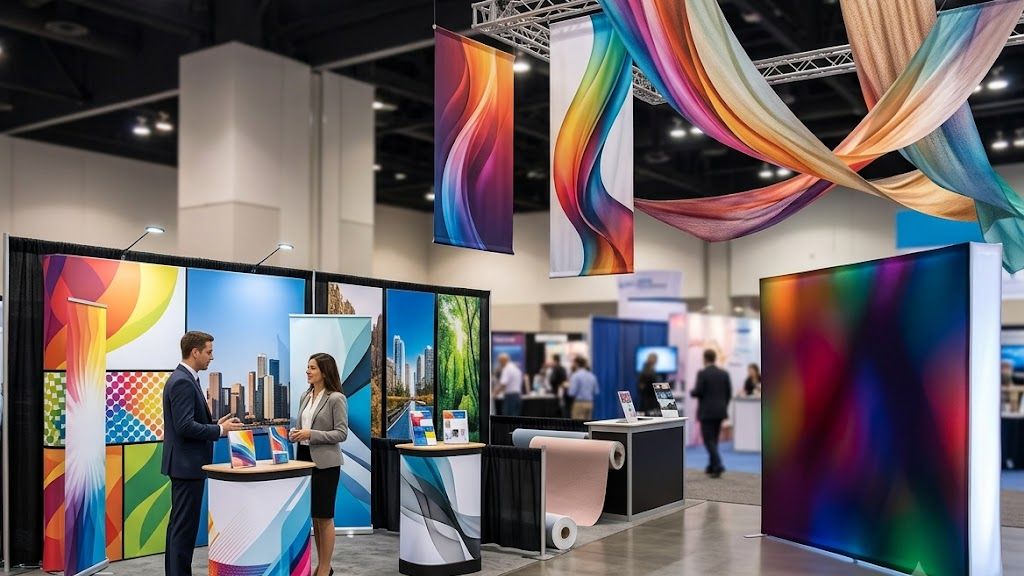
Dye sublimation fabric is the stock behind most modern soft signage: retail displays, trade show booths, backlit light boxes and tension frame graphics. It prints bright, ships folded instead of rolled, and carries no PVC. The catch is that the fabrics are not interchangeable. Buy one your press cannot run, or one that stops 70 inches short of your finished width, and you have bought a reprint you cannot bill. This guide walks the four checks a print provider actually makes before ordering a roll, using the published specs on UltraFlex’s own product pages.
Key takeaways
- Check the line before anything else. In the VorTex™ Soft Signage range, 24 of the 35 fabrics run dye sublimation. All ten S Line fabrics are UV, latex and solvent only.
- D Line fabrics take direct dye sublimation, T Line fabrics take transfer. Sixteen fabrics accept both, so one roll can cover either workflow.
- Then spec weight (3.24 to 10.03 oz/yd²), opacity (single layer versus a white-black-white blockout), stretch (rigid weave versus knit for silicone edge graphics) and width.
- Width is the trap. Most of these fabrics top out at 126 inches. One reaches 198.
- Fire listings are held per product, not per range. Read the certificate for the exact fabric before you quote a regulated venue.
How Dye Sublimation Puts the Image Inside the Cloth
Dye sublimation fabric is a polyester or polyester-blend textile made to receive disperse dyes under heat and pressure. The solid dye turns straight to a gas, the polymer chains in the polyester open, and the dye moves into the fiber before it cools and sets. The color ends up inside the material rather than sitting on the surface, so it does not crack, peel or change the hand of the cloth.
That is also why the process holds up in the field. Smithers reports that dye-sublimated polyester carries high lightfastness, good washfastness and better abrasion resistance than silk and other delicate fabrics (Smithers, via WhatTheyThink, April 2025). For a print provider that means graphics that survive shipping, repeated installs and years of retail lighting.
The market underneath it is not small. The same Smithers analysis put global dye sublimation print at $10.51 billion, forecast to reach $15.2 billion by 2029 on a 7.9% compound annual growth rate. Garments are the largest segment; display and signage work is a smaller share of that total, which is worth knowing when you read a headline number. On the shop side, the 2023 FESPA Print Census found 1,778 printers and sign makers across more than 120 countries defining their business focus as graphics (61%), signage (26%), textile (24%) and industrial (14%) (FESPA).
The practical pull is simpler than the market data. A fabric graphic weighs a fraction of a vinyl banner, folds into a box instead of a tube, and comes out wrinkle-resistant. It is non-reflective under display lighting. It contains no PVC, which takes the disposal question off the table. UltraFlex holds this category in its VorTex™ Soft Signage range, supplied to the United States, Canada and Latin America from its Riverview, Florida headquarters and five North American warehouses.
Check One: The Line Has to Match Your Press
This is the check that costs the most when it is skipped, so make it first. UltraFlex splits VorTex Soft Signage into three lines, and only two of them are dye sublimation stock.
- D Line — 18 fabrics, built for direct dye sublimation. You print the dye straight onto the fabric on a textile printer and fix it with heat in one pass. Seventeen of the 18 accept direct dye sublimation; the exception, ReSource™ Eclipse® D260, is a UV and latex fabric sitting in the same line.
- T Line — 7 fabrics, coated for transfer. You print a mirrored image onto sublimation paper, then marry paper to fabric in a heat calender. All seven are transfer fabrics; none of them takes direct dye sublimation.
- S Line — 10 fabrics, and none of them is dye sublimation stock. Every S Line product is coated for UV and latex, and several add solvent and eco-solvent. VorTex™ Backlit Prism S155 is a good example: a 4.6 oz bright-white backlit textile that goes to 200 inches wide, listed for UV and latex only. It is an excellent backlit fabric and the wrong thing to load for a dye sublimation job.
Sixteen fabrics in the range accept both direct and transfer dye sublimation, which is the useful middle ground. If you run a calender now and expect to buy a textile printer later, those sixteen let you change method without changing stock. The printability list on each product page is the authority; check it rather than inferring from the letter in the product code.
What the range actually holds
Four numbers to check before you order a roll
Counted off the published specs of every fabric in the VorTex Soft Signage range.
24 of 35
fabrics run dye sublimation. The ten S Line fabrics are UV, latex and solvent only.
16
accept both direct and transfer, so one roll covers either workflow
3.24–10.03
oz/yd² weight span, from the Flag D110 to the Heavy D340 and T340
1
dye sublimation fabric reaches 198 in. Most of the rest stop at 126.
Checks Two to Four: Weight, Opacity and Stretch
Once the line is right, three material properties decide the job.
- Weight, in oz/yd². The dye sublimation fabrics in this range run from 3.24 oz to 10.03 oz. Light fabrics drape and move: VorTex™ Flag D110 is a 3.24 oz knit with good wind flow, listed for banners, feather flags and theatrical backdrops. Heavy fabrics hold tension flat and resist creasing: VorTex™ Heavy D340 is a 10.03 oz knit for backdrops, SEG displays, table throws and pop-ups. In the middle, VorTex™ Grand Display D223 is a 6.5 oz tight knit that UltraFlex lists as crease-free for roll-up and pop-up displays.
- Opacity. A single-layer fabric is fine for single-sided and backlit work. Light from behind or from an odd angle needs a blockout. VorTex™ Blockout D252 is an 8.26 oz woven with a white-black-white triple-layer construction that UltraFlex describes as almost completely opaque. For a softer hand, VorTex™ Stretch Eclipse® D250 is a 7.37 oz black-back blockout with slight stretch, and VorTex™ Triple White D251 is a 7.4 oz tight weave that carries more opacity than other fabrics of similar weight, for both front-lit and back-lit use.
- Stretch. Silicone edge graphics have to seat into an extrusion without pulling. VorTex™ Soft Stretch D221 is a 6.48 oz knit that UltraFlex lists as more opaque than comparable stretch products, which is what hides frame and tubing structures behind the graphic. VorTex™ Super Stretch D231 is the 9.17 oz version, and UltraFlex notes it is geared toward an experienced printer. VorTex™ Stretch D235 is a poly-spandex knit where you need more give again.
Width is the fourth number and the one that quietly breaks jobs. Across this range 126 inches is the normal maximum. Grand Display D223 is the only dye sublimation fabric here that goes to 198 inches; Stretch Eclipse D250 and ReSource Eclipse D260 reach 196. So if the finished graphic is a 14-foot booth wall in one piece, the fabric choice is effectively made for you before you get to weight or opacity. Work the other way and you will be designing a seam you did not want.
Order a sample and run a test target before you commit a full roll. Opacity and color response differ between knits and wovens, and between direct and transfer on the same fabric.
Matching the Fabric to the Display
- Silicone edge graphics and tension frames. Use a stretch knit, and finish it with the VorTex™ Clear Gasket, a 14 mm x 3 mm PVC gasket with an integrated sewing line, supplied in boxes of five 164-foot spools. Our companion guide on choosing the right tension fabric covers the frame side of the decision.
- Backlit light boxes. You want a built-in diffusion layer, not just a light fabric. VorTex™ Backlit LX D300 is an 8.84 oz knit with a brushed backside and a diffusion layer for uniform illumination; VorTex™ Backlit Optimum D270 is a 7.96 oz satin-finish woven with the same feature. Both take direct and transfer dye sublimation. If your backlit work runs UV or latex instead, that is where the S Line belongs, and our backlit media guide covers the film options.
- Double-sided banners and hanging signs. Use a blockout so the reverse image does not ghost. Stretch Eclipse D250 gives you a black back with enough stretch to install easily; Blockout D252 is the harder, more opaque option.
- Flags and fence graphics. Flag D110 at 3.24 oz handles indoor and short-term outdoor work. VorTex™ Fence Mesh D150 is a 4.42 oz polyester mesh that UltraFlex positions as a fabric alternative to traditional PVC mesh, for fence graphics, outdoor banners and flying banners.
- Transfer-only shops. If everything you run goes through a calender, the T Line is your catalogue. VorTex™ Soft Stretch T222 is the 6.48 oz knit and VorTex™ Heavy T340 the 10.03 oz one.
Start from the display and work back to the fabric. A booth backdrop, a retail SEG panel and an outdoor flag all print well on dye sublimation fabric, and each one wants a different weight, opacity and construction.
Fire Listings Are Held Per Product, Not Per Range
Trade shows, retail centers and public venues ask for a specific listing, and a range-level claim will not satisfy an inspector. Of the 24 dye sublimation fabrics in the VorTex Soft Signage range, the published product pages show 20 listing NFPA 701, nine listing a California Title 19 or CA 1237 rating, three listing Canada ULC, and two listing ASTM E84 — Super Stretch D231 and Triple White D251. Four fabrics show no published fire listing at all: Stretch D235, Silverback Flag D150, BioFlex® Cotton D280 and ReSource™ Backlit Event T202.
The gaps matter as much as the listings. If a venue names ASTM E84, only two fabrics here answer it. If it names Canada ULC, you are choosing between Flag D110, Blockout D252 and Backlit LX D300. Pull the certificate for the exact product from the UltraFlex fire certificates page, or the Fire Certificates download on the product page itself, and put that document in the job file before you quote.
Recycled and PVC-Free Dye Sublimation Fabric
Recycled content is now a line item on requests for quote rather than a nice-to-have. In the FESPA census, 70% of respondents said they can address sustainability demands without raising prices, and a further 22% had already raised prices without an effect on sales (FESPA). Polyester soft signage helps because it contains no PVC and the process uses water-based disperse dyes rather than solvent chemistry.
For a verified claim you need a standard behind it. The Textile Exchange Global Recycled Standard covers products with at least 20% recycled material and verifies the chain of custody behind the claim (Textile Exchange). UltraFlex’s ReSource™ substrates are made with GRS-certified recycled yarns, and several are dye sublimation stock: ReSource™ Glacier D310 is a 9 oz 100% GRS-certified recycled polyester soft blockout, and ReSource™ Star Eclipse® D270 is the 7.6 oz version. Note that ReSource™ Eclipse® D260, despite the D code, is UV and latex only. If you are fielding recycled-content questions on banner jobs as well, our recycled banner material guide covers how those options are specified.
Frequently Asked Questions
What fabric is used for dye sublimation?
Polyester and high-polyester blends. Disperse dyes bond only to polyester fibers, so the higher the polyester content, the brighter and more permanent the result. The VorTex dye sublimation fabrics are 100% polyester or polyester blends made for the process; the cotton and canvas products in the wider range are not dye sublimation stock.
What is the difference between direct and transfer dye sublimation fabric?
Direct fabrics print on a textile printer and fix in one heat pass. Transfer fabrics print onto sublimation paper first, then bond to the fabric in a heat calender. In the VorTex range, 17 fabrics take direct, 23 take transfer, and 16 take both. Choose the line that matches the press you already run.
How wide does dye sublimation fabric come?
In this range, most fabrics top out at 126 inches. VorTex Grand Display D223 goes to 198 inches, and Stretch Eclipse D250 and ReSource Eclipse D260 reach 196. Match the roll width to the finished graphic first, because it narrows the choice more than any other spec.
Is dye sublimation fabric fire resistant?
It depends on the product, not the range. Twenty of the 24 dye sublimation fabrics in the VorTex Soft Signage range list NFPA 701 on their product page, two list ASTM E84, three list Canada ULC and nine list a California Title 19 or CA 1237 rating. Four list none. Confirm the certificate for the exact fabric before you quote a regulated venue.
Is dye sublimation fabric better than vinyl?
For soft signage it is usually the easier product to ship and install: lighter, foldable, non-reflective and PVC-free. Vinyl still holds long-term outdoor and structural banner work, where a coated fabric is not the right substrate. The answer is set by the application, not by the material.
Can I print dye sublimation on an S Line fabric?
No. All ten S Line fabrics are listed for UV and latex, and several for solvent and eco-solvent. They are not coated for dye sublimation. If your press is a dye sublimation printer or a calender, buy from the D Line or the T Line.
To spec a fabric for a specific job, compare the published weight, width, printability and fire listing on each product page in the VorTex™ Soft Signage range, then request a sample and print a test target on your own press before committing a roll. If you are not sure which line matches your equipment, UltraFlex customer service can narrow it down first.