
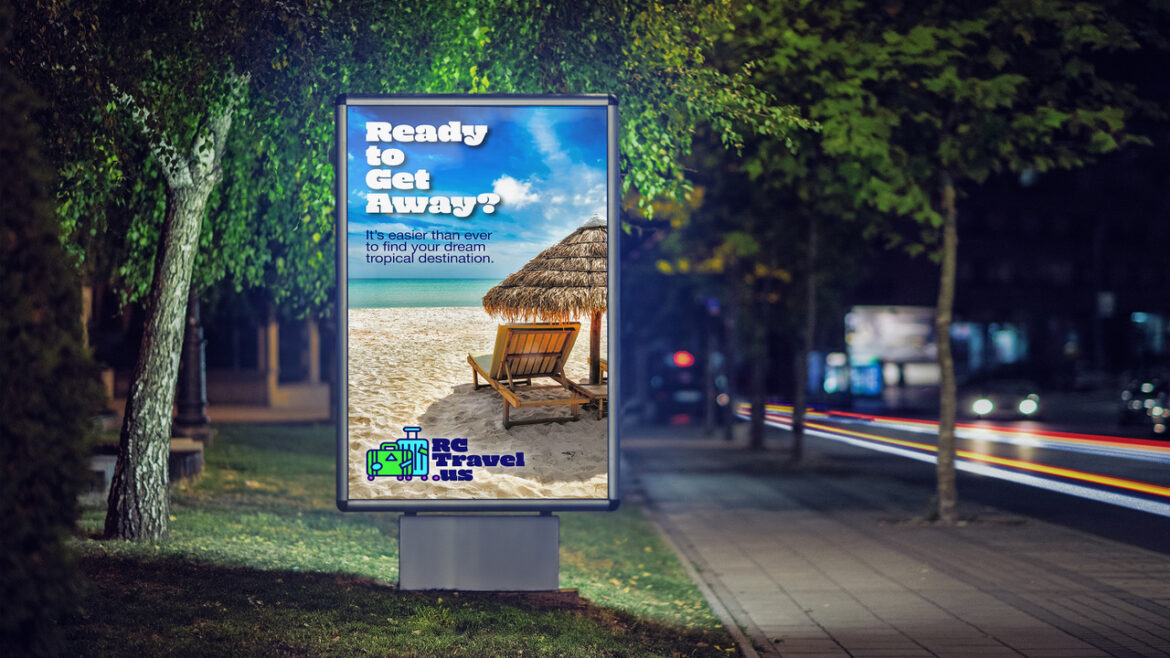
Backlit film is a translucent print substrate designed to be lit from behind, so a graphic glows with even, saturated color inside a light box, display case, or illuminated sign. Choosing the right backlit media is mostly a question of matching the base material, weight, and ink system to how the piece will be lit and where it will live. Get that match right and the print reads clean and bright with no hot spots. Get it wrong and you see banding, pinholes, or a washed out image the moment the lights come on.
This guide walks print buyers and production managers through what backlit film is, how it differs from frontlit media, the specs that actually matter, and where it performs best.
Key Takeaways
- Backlit film is a translucent substrate printed to be illuminated from behind, used in light boxes, displays, and internally lit sign faces.
- The two common bases are smooth PET film and woven polyester fabric. Film gives a glass-flat surface for framed light boxes, while diffusion-layer fabric spreads light evenly across large tension displays.
- Match weight, opacity, and the light-diffusion layer to your fixture. A dedicated backlit product resists the hot spots and pinholes you get when you push a frontlit material into a light box.
- Confirm ink compatibility before you buy. Backlit media are formulated for specific systems such as UV, latex, solvent, and dye sublimation.
- Backlit graphics sit inside a growing illuminated-display market, and a stocked North American supplier keeps high-volume shops from waiting on backorders.
What is backlit film?
Backlit film is a print media engineered so light passes through it evenly, letting a printed image glow from within a fixture instead of relying on reflected room light. It is the material behind mall light boxes, airport dioramas, menu boards, retail displays, and internally illuminated sign faces.
Demand for illuminated messaging keeps climbing. U.S. out of home advertising revenue reached a record $9.46 billion in 2025, up 3.6% year over year, with digital out of home making up 36.3% of that total, according to the Out of Home Advertising Association of America. A large share of that spend lives on lit structures, and every static backlit box in that mix still needs a printed film to carry the image.
Backlit demand
Where backlit media gets used
Out-of-home scale, the digital share, and a representative spec.
Out of Home Advertising Association of America; UltraFlex Systems.
The defining trait is translucency. A backlit film is built to transmit and diffuse light rather than block it, which is why a material made for frontlit banners rarely performs well the moment you put a lamp behind it.
Backlit film vs. frontlit media: what is the difference?
The difference is the direction of the light. Frontlit media reflects light from the image side and is read by ambient or fixture light hitting the face, while backlit media is illuminated from behind and is read by light passing through it. As UltraFlex explains in its own breakdown of frontlit versus backlit banner materials, frontlit substrates are optimized for brightness and readability under front lighting, and backlit substrates are built for color vibrancy and definition when lit from the back.
That distinction drives material design. Frontlit banners often carry a gray or black block-out layer to stop light and shadowing. Backlit film does the opposite. It manages how light spreads so the printed image stays uniform edge to edge. UltraFlex builds backlit media specifically for this job, from the scrim-less SuperSmooth PET BL film at 13.5 oz to woven backlit fabrics tuned for tension frames.
Use frontlit media for billboards, building wraps, and banners read in daylight or under floodlights. Use backlit film when the fixture lights the graphic from behind and you need the color to carry that glow.
What specs should you check before buying backlit film?
Check five specs before you order: base material, weight, opacity and diffusion, ink compatibility, and finishing method. These determine whether the film sits flat, lights evenly, and holds up in your fixture.
Base material is the first fork. Smooth PET film delivers a glass-flat surface that keeps fine detail crisp, which is why 3M lists its translucent cast vinyl graphic films at roughly 2 mil thickness for internally illuminated sign faces, backed by up to nine years of outdoor durability under its MCS warranty. Woven polyester fabric takes a different path, using a satin surface and a built-in light-diffusion layer to wash light across large formats without visible pinholes. The VorTex Backlit Optimum D270, a 100% polyester woven media, is designed exactly for that even, pinhole-free illumination.
Ink compatibility is where orders go wrong most often. Confirm the media is formulated for your press before buying. The table below compares two common backlit approaches from a single supplier.
| Media | Base | Weight and finish | Ink compatibility | Best for |
|---|---|---|---|---|
| SuperSmooth PET BL | PET film, scrim-less | 13.5 oz, ultra-smooth, non-curl | Solvent, eco-solvent, UV, screen | Framed light boxes and rigid light-box faces |
| VorTex Backlit Optimum D270 | 100% woven polyester | Satin finish with light-diffusion layer | Dye sublimation (transfer and direct), UV, latex | Large SEG light boxes and even, pinhole-free washes |
For finishing, a non-curl formula matters when the film has to drop cleanly into a frame, and a scrim-less build keeps the surface from telegraphing texture through the lit image. If you print latex, verify the media is certified for it. UltraFlex maintains a list of HP Latex certified media and posts full technical data sheets so you can match specs before committing to a roll.
Where does backlit film perform best?
Backlit film performs best anywhere a fixture lights the graphic from behind: light boxes, tension-frame displays, retail and menu boards, transit dioramas, and internally illuminated sign faces. The pull toward illuminated formats is strong. The global digital signage market is projected to reach $45.94 billion by 2030 at an 8.1% compound annual growth rate, per Grand View Research, and printed backlit graphics remain the lower-cost, higher-resolution option for the many light-box faces that sit alongside those screens. Transit and street furniture lean on backlit dioramas in particular, a segment reinforced by the double-digit digital out of home growth the OAAA reported.
Indoor environments are the sweet spot. Backlit media shine in tradeshow booths, storefront displays, and lobby light boxes where controlled illumination shows off color depth. They also work outdoors in arena displays and bus-shelter dioramas, though UltraFlex advises steering clear of direct sunlight placement, since strong front light competes with the fixture and flattens the glow the material is built to deliver.
Silicone edge graphic frames and tension displays are a natural fit for the fabric route, where the diffusion layer keeps a large lit surface uniform. Rigid light boxes and smaller framed faces favor the flat PET film.
How do you avoid the most common backlit printing mistakes?
Avoid the four failures that ruin backlit jobs: uneven illumination, weak ink saturation, poor color management, and visible seams. Each traces back to a mismatch between the media, the file, and the fixture.
Uneven illumination and hot spots usually mean the media lacks a diffusion layer or the light source sits too close to the face. Picking a backlit product with a dedicated diffusion layer, like the woven VorTex line, spreads the light. Weak saturation shows up when a film built for one ink system is run on another, so match the media to your press and lay down enough ink density to hold color once the box is lit. Backlit graphics need heavier ink coverage than the same art printed for frontlit viewing, because the light behind them thins the apparent color.
Color management is the quiet culprit. Print a backlit file with a frontlit profile and the lit result will look pale, so use the correct ICC profile for backlit output and proof against a light source, not just a desktop. UltraFlex publishes ICC profiling support and per-product data so operators can dial this in before the run. For seams, choose a width that covers the face in one piece where possible, or plan welds and stitched seams that fall outside the lit viewing area.
How do you source backlit film for high-volume print shops?
Source backlit film from a supplier that stocks the full range in depth, because backorders on a single width stall an entire production schedule. The wider print category is expanding, with the large format printing market sitting at $12.68 billion in 2025 and forecast to reach $16.02 billion by 2030 at a 4.78% compound annual growth rate, according to Mordor Intelligence, and shops winning that volume need materials on the shelf, not on a boat.
UltraFlex Systems supplies digitally printable textiles and substrates and has spent more than 40 years developing and refining these formulas. The company holds over 500,000 square feet of global stock across its product lines and services the United States, Canada, and Latin America through five North American warehouses, so a printer ordering a backlit roll in volume can expect it to ship rather than wait. That inventory depth covers frontlit, backlit, block-out, mesh, and specialty media under one roof.
For a shop specifying its next backlit job, the practical path is to pull the data sheet, confirm ink compatibility, and test the surface before committing to a full run. UltraFlex lets you request a sample of any backlit media so you can proof it on your own press and under your own fixture first.
Frequently Asked Questions
Is backlit film the same as translucent vinyl?
Translucent vinyl is one type of backlit film. Backlit media is a broader category that also includes woven polyester fabrics with light-diffusion layers. Cast translucent vinyl suits rigid, framed light boxes, while backlit fabric suits large tension displays. Both are engineered to transmit and diffuse light rather than block it.
Can backlit film be used outdoors?
Yes, backlit film is used outdoors in arena displays and bus-shelter dioramas, but keep it out of direct sunlight. Strong front light competes with the fixture behind the graphic and flattens the glow. For outdoor use, confirm the media and inks carry an outdoor durability rating, such as a multi-year warranty on translucent films.
What weight of backlit film do I need?
Weight depends on the fixture and format. A film such as SuperSmooth PET BL runs 13.5 oz and drops flat into framed light boxes, while woven backlit fabrics are chosen more for their diffusion layer and tension-frame fit than for a specific ounce weight. Match the base and finish to the fixture first, then confirm the roll width covers your face.
What inks work with backlit film?
It depends on the specific media. Some backlit films are formulated for solvent, eco-solvent, UV, and screen inks, while backlit fabrics often accept dye sublimation, UV, and latex. Always confirm the ink system on the technical data sheet before ordering, because running the wrong ink on a backlit substrate is the most common cause of poor saturation.
How is backlit film different from a backlit fabric?
Backlit film is typically a smooth PET or vinyl base that gives a glass-flat surface for crisp detail in rigid light boxes. Backlit fabric is a woven polyester with a satin surface and a diffusion layer built to wash light evenly across large SEG and tension displays. Film favors detail and flatness, fabric favors even illumination at scale.
Sources
- Out of Home Advertising Association of America, Out of Home Advertising Revenue Reaches Record $9.46 Billion
- Grand View Research, Digital Signage Market Size To Reach $45.94 Billion By 2030
- Mordor Intelligence, Large Format Printing Market Size and Forecast
- 3M, Scotchcal Translucent Graphic Film 3630