Mesh banner material is a coated polyester scrim built with an open weave, punctuated by thousands of small holes that let air pass straight through the print. That one design choice is why print shops reach for mesh whenever a graphic has to survive weather. Instead of behaving like a sail, a mesh banner bleeds wind pressure through its face. UltraFlex Systems has built an entire UltraMesh line around that principle, with published airflow that runs from 25% on its image-grade scrim up to 45% on its high-wind grade.
This guide walks a print service provider through the decisions that actually matter when you spec mesh: how much air the weave should release, how heavy the scrim needs to be, when opacity beats airflow, and which fire listings the job requires.
Key Takeaways
- Mesh banner material vents wind through an open weave, so airflow rating is the first spec to check for outdoor jobs.
- Higher airflow improves wind performance; lower airflow (with tighter holes) improves image sharpness for close viewing.
- Blockout mesh trades some airflow for full opacity, which is what double-sided and billboard prints need.
- Many venues require an NFPA 701 flame listing; UltraFlex mesh also carries ASTM E84 and California Title 19 ratings.
- PVC-free mesh is now a stocked option for teams that need to meet sustainability specs.
What is mesh banner material?
Mesh banner material is a coated polyester scrim engineered with an open weave, and UltraFlex’s UltraMesh Plus is a representative example: an 8 oz. scrim that lets 37% of the wind pass through its printed face. Solid vinyl banners block the wind entirely, which turns a large graphic into a sail that pulls hard on grommets, ropes, and mounting frames. Mesh solves that by design.
The trade-off is coverage. Because the holes are open, a mesh face shows slightly less ink density than a solid banner, and a small amount of light passes through. Manufacturers manage that trade-off by changing the size and pattern of the holes. UltraFlex’s UltraMesh Supreme, for instance, uses slit-shaped holes rather than round punches so the printed image reads cleanly even at close range. The result is a family of materials that all vent air, but at different rates, for different distances and different wind loads.
Why wind changes everything for outdoor banners
United States out-of-home advertising revenue reached a record $9.1 billion in 2024, a 4.5% increase over the prior year, according to the Out of Home Advertising Association of America. A large share of that spend hangs outdoors on fences, scaffolds, building faces, and stadium rails, which is exactly where wind does the most damage to a printed graphic.
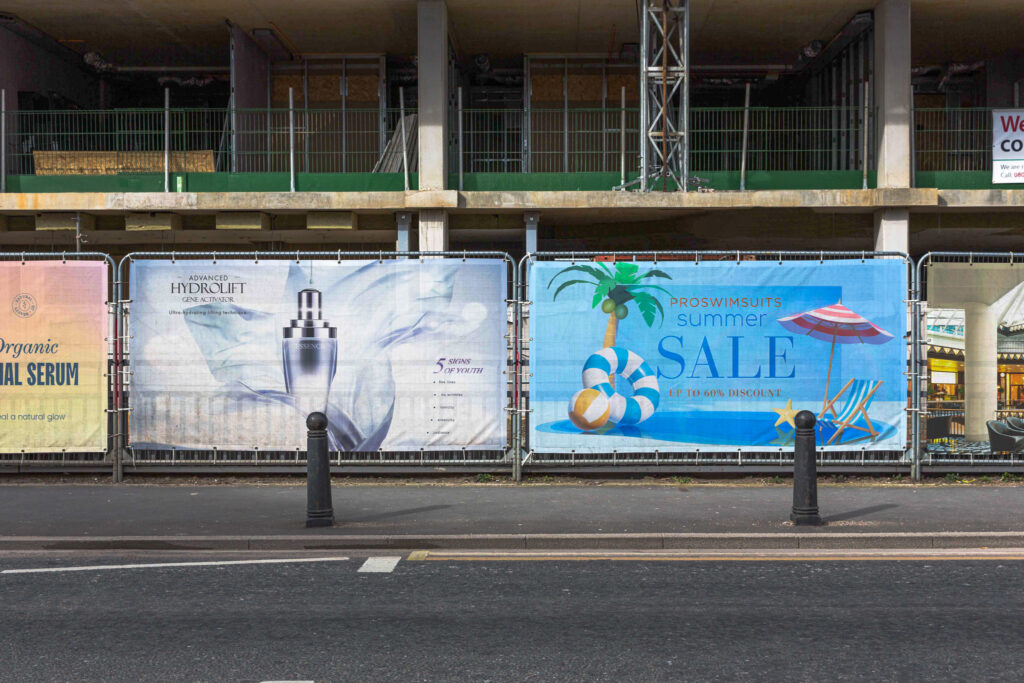
Wind load rises with the surface area the banner presents to a gust. A solid banner presents all of it. A mesh banner presents far less, because air moves through the weave instead of pushing against it. That means fewer torn hems, fewer bent frames, and fewer emergency call-backs after the first storm. For any building wrap, fence wrap, or barricade graphic, the airflow rating is the single most useful number on the spec sheet, and it should be the first thing you match to the site.
Airflow and weight: matching mesh to the job
UltraFlex grades its mesh by how much air the weave releases, from 25% on UltraMesh Supreme up to 45% on UltraMesh Eclipse. Lower airflow keeps more ink on the face and reads sharper up close; higher airflow sheds more wind and suits exposed, high-rise, or long-span installs. Weight tracks alongside that: heavier scrims resist stretch and tearing on big spans, while lighter scrims cost less and hang easily on short runs.
| Grade | Weight | Airflow | Best fit |
|---|---|---|---|
| UltraMesh Supreme | 9 oz/yd² | 25% | Fine text and close-viewing graphics |
| UltraMesh Premium 100 | 10 oz/yd² | 30% | Large building and stadium wraps |
| UltraMesh Plus | 8 oz/yd² | 37% | Fence wraps and budget building wraps |
| UltraMesh Eclipse | 7.96 oz/yd² | 45% | High-wind sites that also need opacity |
Use the table as a starting point, not a rulebook. A short fence banner in a sheltered courtyard can run a low-airflow grade for a crisper image, while the same artwork on an exposed 30-foot span should move up to a higher-airflow, heavier scrim. When two jobs sit close together on the chart, order a sample of each and hang them at the real viewing distance before committing a full roll.
Spec guide
How much wind each UltraMesh grade lets through
Airflow is the first decision on an exposed span: the more wind the weave releases, the less sail load the frame carries.
Blockout mesh: opacity for double-sided and high-contrast jobs
UltraMesh Blockout is a 12.5 oz. double-sided mesh that prints on both faces and stays fully opaque, which is what billboards, exhibits, and event signs need when light must not bleed through from behind. A standard single-face mesh lets some light pass, so a bright background or a second graphic on the far side can ghost through the front. Blockout construction stops that.
UltraMesh Eclipse takes a different route to the same goal: a black backing layer gives it complete opacity while still venting 45% of the wind. That combination, opacity plus high airflow, is unusual and genuinely useful on tall, exposed installs where a designer still wants deep, solid color. If a job calls for opacity, decide early whether you also need both faces printed, because that single answer points you at either a black-backed single-face grade or a true double-sided blockout media roll.
Fire ratings: what NFPA 701 and ASTM E84 actually require
To pass NFPA 701, a vertically hung textile can lose no more than 40% of its weight after a 45-second flame and must self-extinguish with under 2 seconds of drip burn. That standard governs banners, awnings, and architectural fabrics, and most stadiums, convention centers, and municipalities will ask for the certificate before a large graphic goes up. Speccing a mesh that already holds the listing keeps a job from stalling at the permit stage.
UltraFlex mesh is built to clear those hurdles. UltraMesh Plus, for example, carries NFPA 701 along with ASTM E84, California Title 19, and CSFM listings, while the heavier Supreme, Premium 100 and Premium 328 grades add CANADA ULC and, on the Premium grades, NY MEA. ASTM E84, the Standard Test Method for Surface Burning Characteristics of Building Materials, rates a material by flame spread and smoke, and its top Class A tier means a flame spread index of 0 to 25 and a smoke developed index of 450 or less. When a spec sheet or an architect asks for Class A, that is the number they mean. Keep the current fire certificate on file, since editions and expirations change.
Sustainable mesh without the PVC
The large format printer market is projected to grow from $7.94 billion in 2025 to $10.36 billion by 2030, a 5.5% compound annual rate, with eco-friendly inks and materials named among the drivers, according to MarketsandMarkets. Buyers are increasingly asked to prove that the substrate under the ink meets a sustainability standard, not just the printer and the ink set.
That is where a PVC-free option earns its place on the shelf. UltraMesh EcoVantage is a 100% PVC-free and phthalate-free mesh that carries the same open-weave, wind-shedding behavior as the rest of the line, so a shop can answer a green-building brief without redesigning the job. For teams standardizing on lower-impact media across the board, UltraFlex documents its broader program on its sustainability page. The point is not to compromise on performance; it is to match the material to the client’s environmental spec while keeping the print and finishing workflow the same.
Printing and finishing mesh banners
UltraFlex stocks its mesh in 126-inch and 196-inch widths, depending on grade and rates it for solvent, eco-solvent, UV, and latex inks on printers fitted with a mesh kit, so most wide-format shops can run it without new hardware. The mesh kit matters: it catches ink that would otherwise pass through the holes and mist onto the platen, and skipping it is the most common reason a first mesh job gets messy.
If your workflow struggles with an open weave, a liner grade solves it. UltraFlex offers Strip Mesh versions with a PVC backer that stays on during printing for a clean, solid pass, then peels away afterward to reopen the airflow. On the finishing bench, mesh takes standard hems, welds, and grommets, and one habit changes from solid vinyl work: you rarely need to cut wind slits, because the material already vents on its own. Before a full run, pull real specs from the current technical data sheets and confirm width, weight, and ink compatibility against your printer.
Frequently Asked Questions
What is mesh banner material used for?
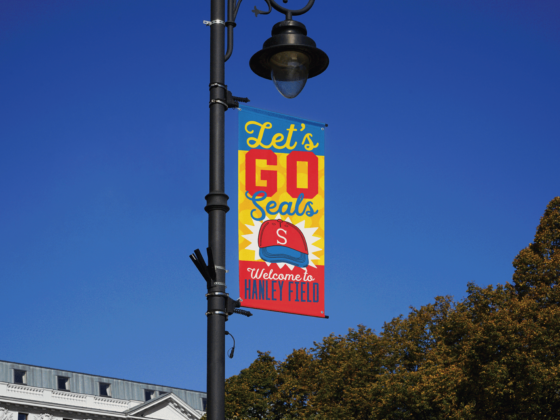
Mesh banner material is used for outdoor graphics that face wind, including building wraps, fence wraps, construction barricades, stadium signage, and pole banners. Its open weave lets air pass through, which lowers wind load and helps large prints stay intact and mounted.
How much wind can a mesh banner handle?
There is no single wind number, because it depends on the airflow rating, the scrim weight, the span, and how the banner is mounted. As a rule, a higher airflow grade on a heavier scrim, tensioned and grommeted correctly, handles more exposure than a low-airflow grade on a light scrim. Match the grade to the site and follow the mounting guidance on the data sheet.
Is mesh banner material fire rated?
Many mesh materials are. UltraFlex mesh carries NFPA 701 flame listings, and several grades add ASTM E84, California Title 19, CSFM, and regional approvals. Venues often require the current certificate before installation, so confirm the listing and keep a copy on file.
Can you print mesh banners on both sides?
Yes. Double-sided grades such as UltraMesh Blockout and UltraMesh Premium 100 are built to print on both faces, and blockout construction keeps them opaque so the two images do not show through each other.
What is the difference between mesh and blockout banner material?
Standard mesh vents the most air and lets a little light through, which is ideal for single-face outdoor graphics. Blockout mesh adds an opaque layer so no light passes, which is what double-sided and billboard prints need, usually at the cost of some airflow.
Is there a PVC-free mesh banner option?
Yes. UltraMesh EcoVantage is a PVC-free and phthalate-free mesh that keeps the same wind-shedding weave, so shops can meet a sustainability spec without changing the print and finishing process.
Ready to match a grade to a real job? Compare weights and airflow across the UltraMesh line, then request a sample and hang it at the actual viewing distance before you commit a full roll.